
There’s a reflex that kicks in whenever someone proposes monitoring an asset more closely: we’ll need to instrument it. More sensors, more wiring, more I/O, a capital request, a shutdown to install it all. For heat exchangers, that reflex is usually the reason condition monitoring never gets off the ground — the business case collapses under the cost and disruption of getting the data before anyone’s seen a single insight. It’s worth pausing on that reflex, because for heat exchangers it’s very often wrong. In most plants, the data you’d need is already being collected.
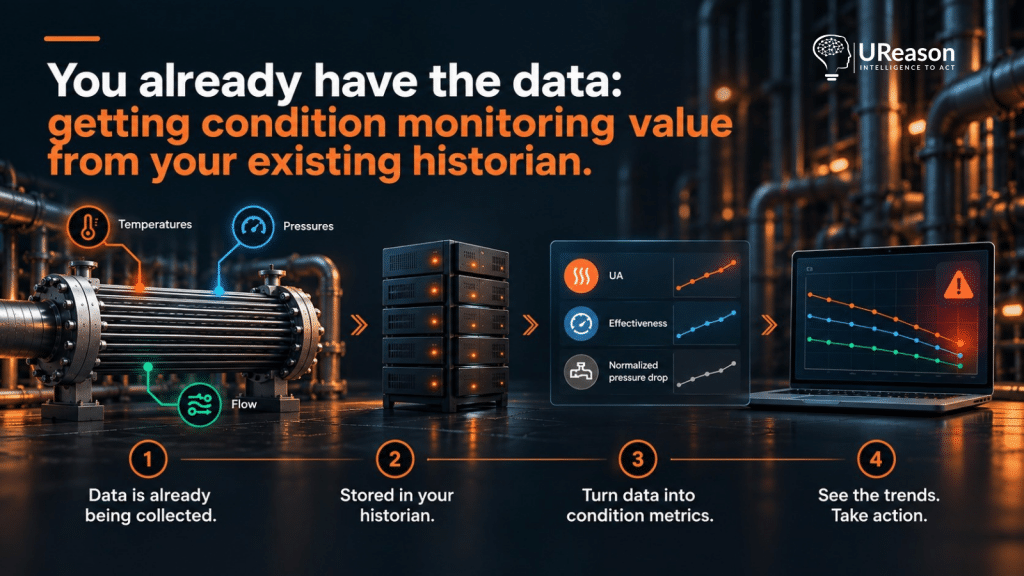
Consider what condition monitoring actually asks for. To track an exchanger’s thermal health, you need the inlet and outlet temperatures on both sides and a flow rate. To track its hydraulic health, you need the inlet and outlet pressures and, again, a flow. That’s essentially it. And those are exactly the measurements a plant already relies on to operate the unit day to day. Temperatures get controlled. Flows get regulated. Pressures get watched. For any exchanger of real economic significance, those tags almost always exist already — wired into the DCS, trended in the control room, and quietly logged, minute after minute, into the historian.
That’s the part that tends to get overlooked. The historian isn’t just an operational tool for the last shift’s trends. It’s a multi-year archive of exactly the signals condition monitoring runs on. The data needed to calculate a UA, an effectiveness, a normalized pressure drop — and to trend all three over months to reveal fouling — is, for most significant exchangers, already sitting in storage. The measurement problem many plants assume they have was solved years ago, as a side effect of instrumenting the unit to run it.
So if the data’s already there, why isn’t the insight? Because operating data and condition data are collected for different purposes, and nobody’s translated between them. The historian was built to answer “what is the plant doing right now?” — not “is this exchanger losing its ability to do its job?” The raw tags stream in and pile up, but they’re never run through the physics that turns temperatures and flows into a health metric. The information is present; the interpretation is missing. The gap isn’ta hardware gap. It’s an analytics gap.
And an analytics gap is a far cheaper one to close. Instead of a capital project and a shutdown to add sensors, you’re applying a calculation layer to data you already own. The historian tags become inputs to the effectiveness-NTU and normalized-pressure-drop methods; those methods produce trends; those trends surface fouling before it reaches the point of pain. No new instruments, no wiring, no outage — and, crucially, a fast path to value, because the historical data means you don’thave to wait months to build up a trend. It’s often already there in the archive, waiting to be read.
There are honest caveats, and later posts will get into them — you need the right tags mapped to the right streams, and the data has to be good enough to trust. But the headline holds: for the large majority of exchangers worth monitoring, the barrier was never the sensors. It was the assumption that you needed new ones. The temperatures, flows, and pressures are already flowing into your historian. Getting condition monitoring value out of them isn’t a question of buying instrumentation — it’s a question of finally asking your existing data the right question.
Unlock More Value from Your Existing Historian Data
Book a call with Artur Loorpuu, Senior Solutions Engineer at UReason, to explore how your existing temperature, flow, and pressure data can help monitor heat exchanger health, detect fouling, and support smarter maintenance decisions — without additional instrumentation.