
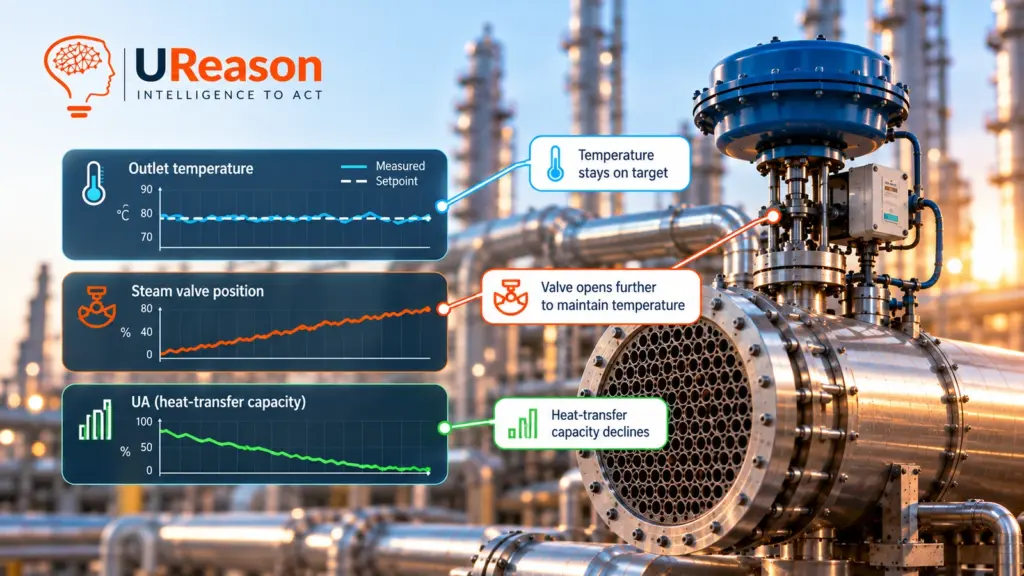
The previous post made a structural argument: the data condition monitoring needs is already in your historian. This one makes a sharper claim. Your control system doesn’t just passively hold the evidence of fouling — it’s actively responding to it, right now, in real time. The exchanger is already telling the DCS it’s fouling. The only thing missing is someone listening in those terms.
How Your DCS Compensates for Heat Exchanger Fouling
Here’s what that means in practice. A heat exchanger almost never sits in isolation; it sits inside a control loop with a job to do — hit a target outlet temperature, hold a downstream condition, deliver a certain duty. When fouling degrades the surface, the exchanger transfers less heat for the same effort. But the process still demands the same result. So the control system does what it’s designed to do: it compensates. It opens a steam valve a little further. It leans harder on a trim cooler. It nudges a bypass. Quietly, automatically, it works around the declining exchanger to keep the process on target.
That compensation is the fouling signal. The valve that used to sit at 40% and now rides at 55% to hold the same temperature isn’t a random drift — it’s the control system spending more and more effort to overcome a surface that’s transferring less and less heat. The exchanger’s decline is written directly into the everyday behavior of the loop around it. The DCS “knows,” in the sense that it’s actively reacting to the problem every minute of every shift. What it lacks is a translation of that reaction into the words “this exchanger is fouling.”
Heat Exchanger Fouling Detection Using Existing Process Data
This reframes the whole question. People imagine detecting fouling requires some special new measurement, a dedicated fouling sensor bolted onto the shell. But fouling doesn’t hide in some exotic parameter you’re not measuring. It hides in plain sight, inside the ordinary operating signals you’re already collecting and controlling on — the temperatures, the flows, the valve positions, the pressures. These aren’t specialized diagnostic instruments. They’re the standard-issue tags every controlled exchanger already has, precisely because you need them to run the unit at all.
When Everyday Adjustments Mask Declining Performance
And there’s a human version of the same story worth naming. Operators frequently compensate for fouling without consciously registering it. The unit runs a little warm, so you bump a setpoint. Throughput sags, so you push a pump a bit harder. Each adjustment is small and reasonable in the moment, and collectively they mask the decline — the process stays on target, so nothing looks wrong. The fouling gets absorbed into “how we run this unit lately.” The signal was there the whole time; it just got smoothed over by the very competence that keeps the plant running.
Turning DCS Control Signals into Actionable Health Metrics
The point of condition monitoring, then, isn’t to go find data that doesn’t exist. It’s to make explicit what the control system and the operators are already doing implicitly. Run those same everyday signals through the physics — effectiveness-NTU on the thermal side, normalized pressure drop on the hydraulic side — and the compensation stops being invisible background effort and becomes a quantified, trendable health metric. The rising valve position becomes a falling UA. The nudged setpoint becomes a number on a chart with a slope you can act on.
No new sensors, because the sensing was never the missing piece. Your DCS has been tracking this exchanger’s decline all along, one small correction at a time. Condition monitoring simply gives that ongoing, silent effort a voice — and turns a problem the system has been quietly absorbing into one you can actually see, plan around, and fix.
Turn Existing DCS Data into Actionable Insights
Book a call with Artur Loorpuu, Senior Solutions Engineer at UReason, to explore how existing control signals, temperature, flow, and pressure data can help reveal developing heat exchanger fouling, track performance, and support better maintenance decisions — without additional sensors.