
Some of the exchangers most worth monitoring are the ones least likely to get it. They’re older units — installed decades ago, running services that matter, sitting on control systems that predate any talk of “condition-based” anything. The instinct is that bringing modern monitoring to a legacy asset means a modernization project: new instruments, new I/O, an outage to install it all, and a capital request that has to compete with everything else on the list. Faced with that, most plants simply leave the old unit alone and hope it holds. The good news is that the instinct is usually wrong — and legacy assets are often the easiest place to start, not the hardest.
The reason ties back to the argument running through this whole cluster: monitoring runs on data you already have, and legacy exchangers have been generating that data for years. An old unit that’s been in service since the plant was built has almost certainly had its key temperatures, flows, and pressures instrumented and logged the entire time — because you needed them to operate it safely. Age doesn’t diminish that. If anything, it works in your favor: a legacy asset comes with a deep historical archive, years of operating data already sitting in the historian. That history is a gift for condition monitoring, because it means you can establish trends and even reconstruct a baseline from data that already exists, rather than starting a trend from zero today.
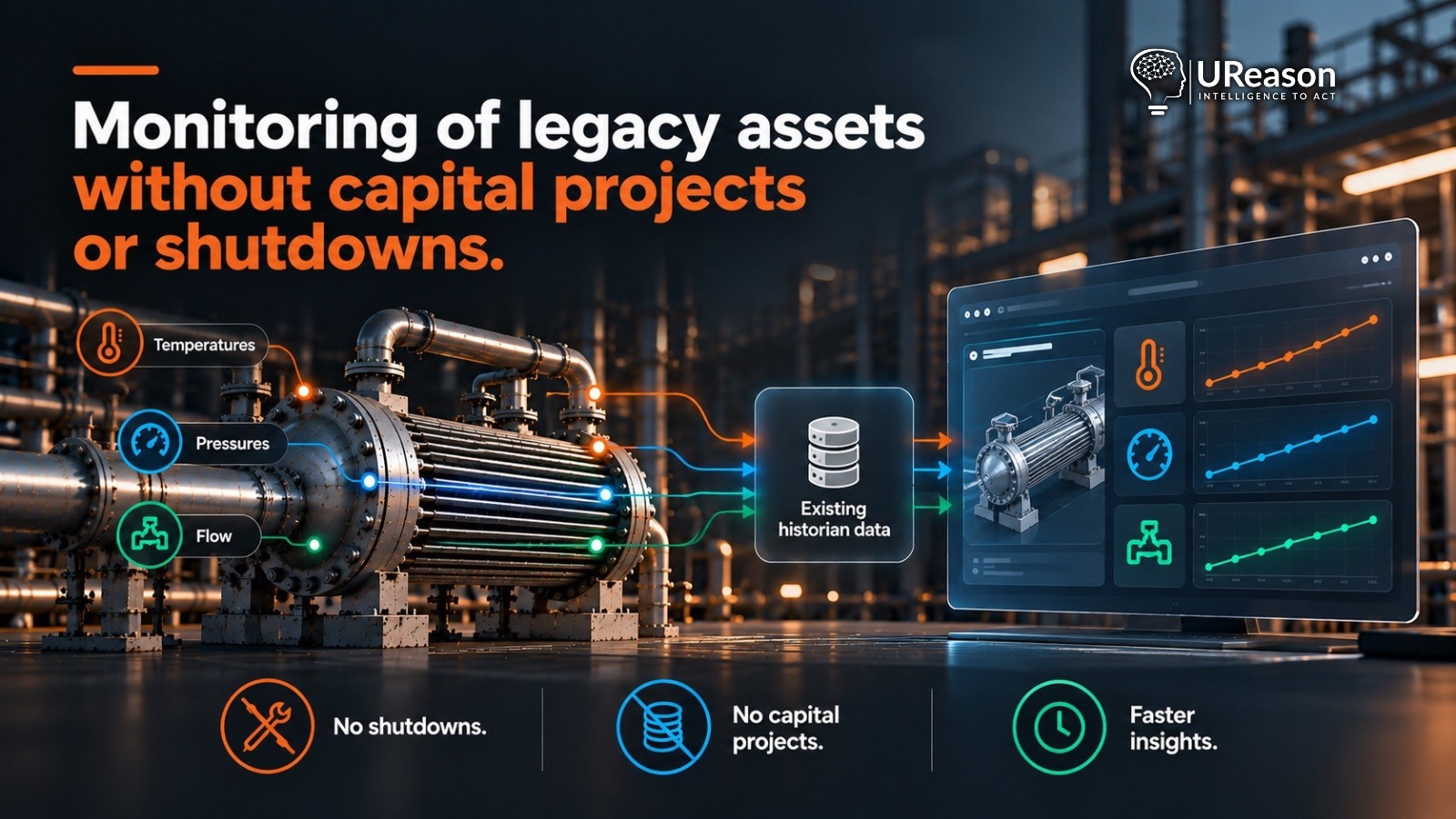
The critical distinction is between the physical asset and the analytics applied to it. Retrofitting monitoring in the conventional sense — adding sensors, running cable, cutting into piping — is invasive. It touches the equipment, so it needs an outage and a budget. But applying a calculation layer to data the historian already holds touches nothing physical at all. There’s no valve to break into, no flange to open, no I/O to wire. The exchanger keeps running exactly as it is while the monitoring is stood up entirely on the data side. It’s a software and analytics exercise, not a mechanical one — which is precisely why it sidesteps both the capital project and the shutdown.
That distinction is what collapses the usual barriers. No shutdown, because you never touch the unit — it stays in service throughout. No capital project, because there’s no instrumentation to buy or install; you’re deploying analytics against existing tags, an expense of a completely different scale. And no waiting, because the historical data means monitoring can deliver insight almost immediately rather than after months of accumulating fresh readings. The old unit that seemed hardest to modernize turns out to be quick to bring into a monitoring program.
There’s a fitting irony in this. Legacy exchangers are often the ones carrying the most risk — older surfaces, longer fouling histories, sometimes past the point where anyone has a clear picture of their condition. They’re exactly the assets where better visibility pays off most, and exactly the ones a sensor-based retrofit would deprioritize on cost. Approaching monitoring as an analytics problem flips that calculus. The assets most in need of insight become among the most accessible, because the barrier was never the equipment’s age — it was the assumption that monitoring meant touching the equipment.
The practical takeaway: don’t let a legacy asset’s age, or the absence of a modernization budget, rule it out of a monitoring program. The question to ask isn’t “what would it cost to instrument this old unit?” It’s “what is this unit’s historian already holding that we’ve never read?” For most legacy exchangers, the answer is: years of exactly the data you need, and no outage required to use it.
Monitor Legacy Assets Without Shutdowns
Book a call with Artur Loorpuu, Senior Solutions Engineer at UReason, to explore how existing historian data can help monitor legacy heat exchangers, detect fouling, and track asset performance without new sensors, capital projects, or shutdowns.