Home/Resources/Article/FMEA, Bowtie & Risk
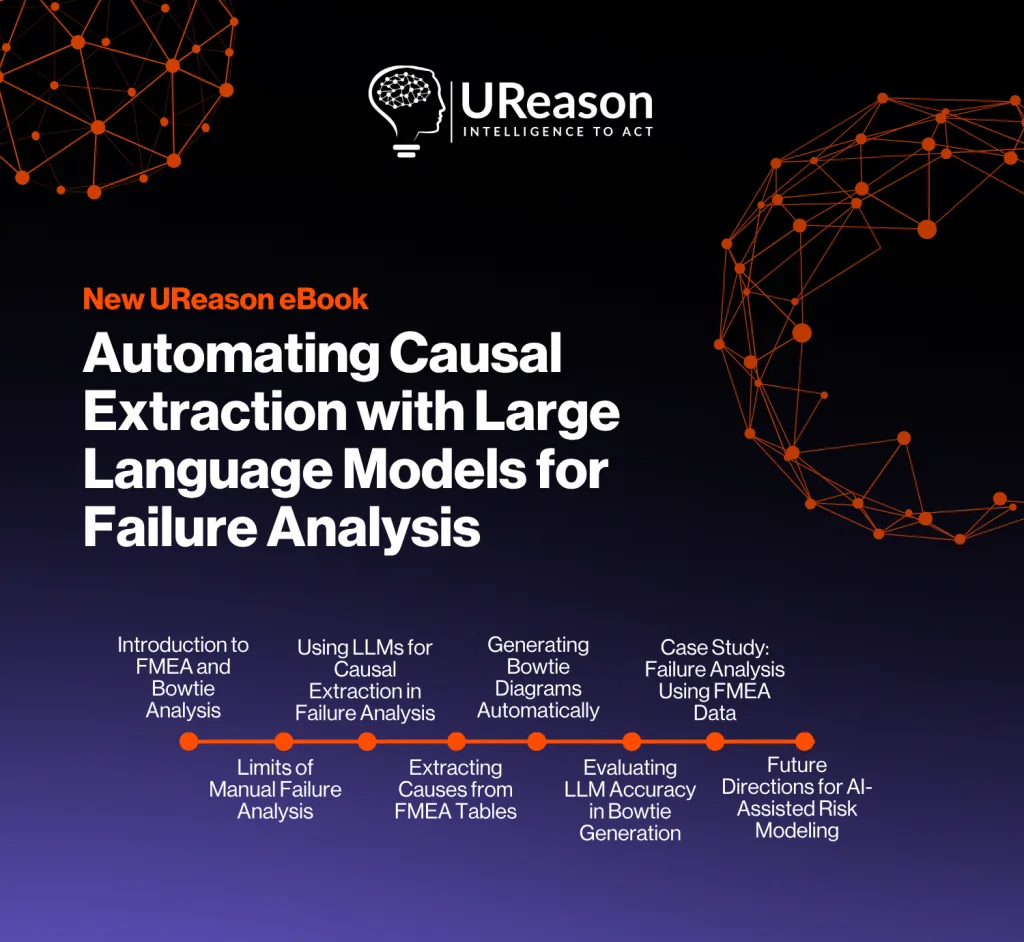
Download UReason’s free eBook on AI-driven failure analysis and discover how Large Language Models can automate causal extraction from engineering documentation. Based on research conducted at the University of Amsterdam, the guide explores how FMEA data can be transformed into Bowtie diagrams to support faster and more scalable reliability analysis.

Gain more information about:
- Automating Causal Extraction
Discover how Large Language Models can identify causal relationships in engineering documentation and translate them into structured risk models. - From FMEA to Bowtie Diagrams
Learn how structured tables and narrative descriptions from FMEA documentation can be transformed into Bowtie diagrams using AI. - LLM Pipelines for Engineering Data
Explore different approaches for extracting causal information, including retrieval-augmented generation, OCR-based processing, and vision-enabled pipelines. - Prompting Strategies for Reliable Results
Understand how prompting techniques and model configurations influence the accuracy and consistency of generated Bowtie diagrams. - Challenges in AI-Assisted Failure Analysis
See where LLMs perform well—such as structured data extraction—and where further improvements are needed, particularly with unstructured engineering narratives.
What’s Inside:
- A Framework for Automating Bowtie Diagram Generation
An overview of the ACE approach for extracting causal relationships from FMEA documentation. - Evaluation of Multiple LLM Models
Insights from experiments using instruction-tuned models including LLaMA, Mistral, and Qwen. - Sensitivity Analysis of Prompting Strategies
Results showing how prompt design and strict schema constraints affect diagram quality. - Structured vs. Narrative Data Extraction
A comparison of model performance when processing structured FMEA tables versus unstructured engineering descriptions. - Future Opportunities for AI in Reliability Engineering
Key lessons and directions for applying large language models to failure analysis and risk modeling.