
The last several posts have made an optimistic case: the data condition monitoring needs is already in your historian, no new sensors required. That’s true — but it comes with an honest asterisk that those posts kept deferring, and it’s time to cash it. “The data is already there” is not the same as “any historian will do.” Monitoring runs on specific tags of adequate quality, and knowing exactly what that means is the difference between a health signal you can trust and a chart that misleads you. So here’s the concrete answer: what’s the minimum you actually need to begin?
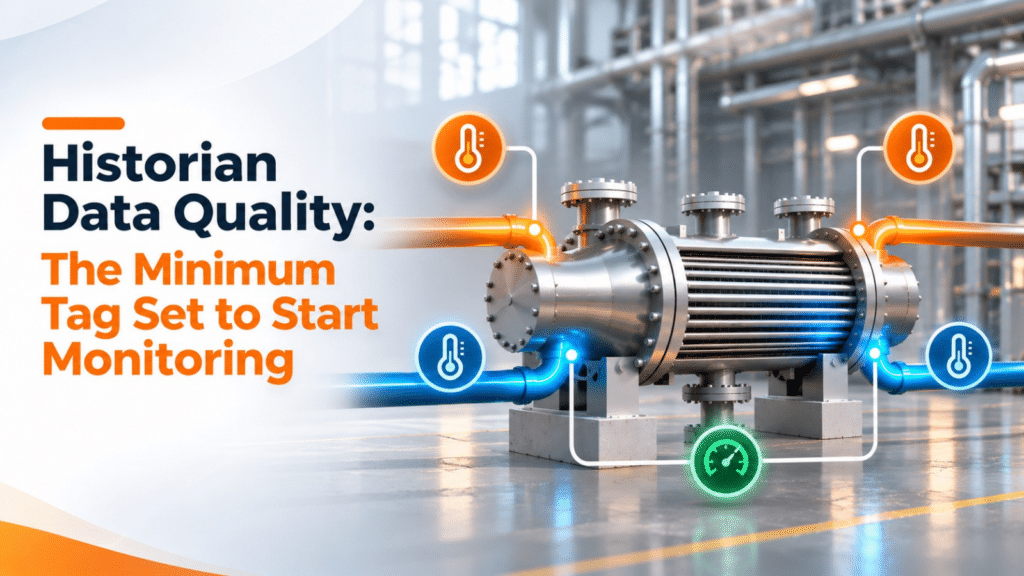
Start with the thermal side. To compute a UA and an effectiveness, you need the four terminal temperatures — inlet and outlet on both the hot and cold streams — plus at least one flow rate. Those five tags are the irreducible core of thermal monitoring; with them you can calculate an exchanger’s heat transfer capacity and trend it. For the hydraulic side, you add inlet and outlet pressure on the side you care about, which — combined with the flow you already have — gives you a normalized pressure drop. That’s the whole shopping list. A handful of tags per exchanger, and for any economically significant unit they very often already exist.
A few practical notes on the flow tag, because it’s the one that trips people up. Flow is doing double duty — it feeds both the thermal calculation and the hydraulic one — so its quality matters more than any single temperature. A missing or unreliable flow measurement is the most common genuine gap, and it’s worth checking first. Sometimes a flow that isn’t directly metered on the exchanger can be inferred from a nearby measurement or a known pump curve, but that’s a judgment call to make deliberately, not a detail to wave past.
Having the tags is necessary but not sufficient — they also have to be good enough, and “good enough” has a few dimensions. Sampling rate matters: fouling is slow, so you don’t need sub-second data, but you do need enough resolution to build a clean trend and to filter out transients. Reliability matters: a tag that spends half its life stuck, flatlined, or reading a sensor fault contributes noise, not signal, and a monitoring layer has to recognize and exclude those stretches rather than trend through them. And basic accuracy matters in a specific way — because UA is derived from temperature differences, small offsets or drift in a temperature sensor can distort the result more than you’d expect. The calculation is only as honest as the tags feeding it.
This is why the first real step in any monitoring effort isn’t analytics — it’s a data audit. Before trending anything, you confirm the minimum tag set exists for each candidate exchanger, that the tags are mapped to the correct streams (a surprisingly frequent error), and that the historical data is complete and sane enough to trust. That audit is also what tells you honestly which units are ready to monitor today and which have a gap to close first — sometimes a gap as small as fixing a mislabeled tag or restoring a flatlined transmitter.
None of this undercuts the core message; it sharpens it. “No new sensors” doesn’t mean “no diligence.” It means the barrier is a data-quality question you can assess from your desk, not a capital question that needs a shutdown. Know the minimum tag set, confirm it’s there and it’s clean, and you’ve cleared the real first hurdle — long before anyone reaches for a purchase order.
Turn Historian Data into Reliable Monitoring Insights
Book a call with Artur Loorpuu, Senior Solutions Engineer at UReason, to explore how your existing temperature, flow, and pressure data can support reliable heat exchanger monitoring, identify data quality gaps, and help detect fouling early without additional sensors.