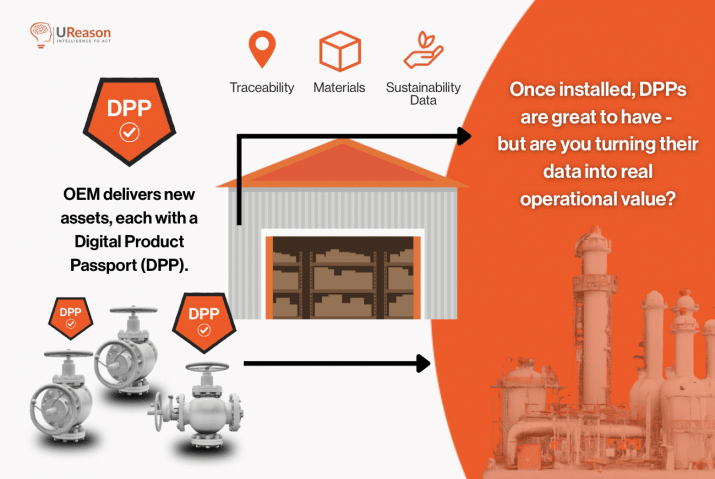
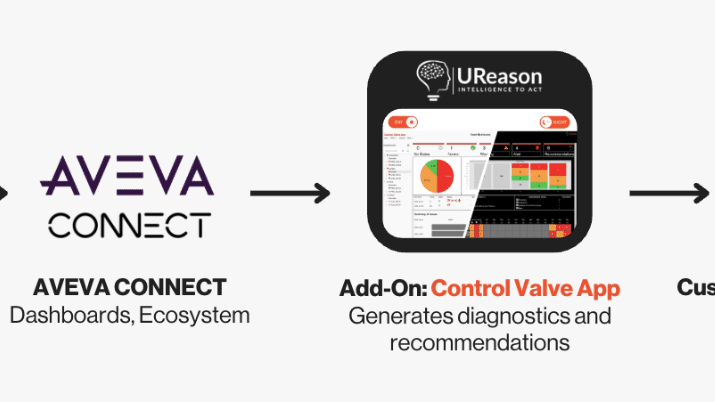
Industrial organizations are under pressure to turn operational data into actionable insight fast. Control valves generate massive volumes of process data every second, but without the right architecture, that data remains trapped in silos.
This blog breaks down the full technical flow:
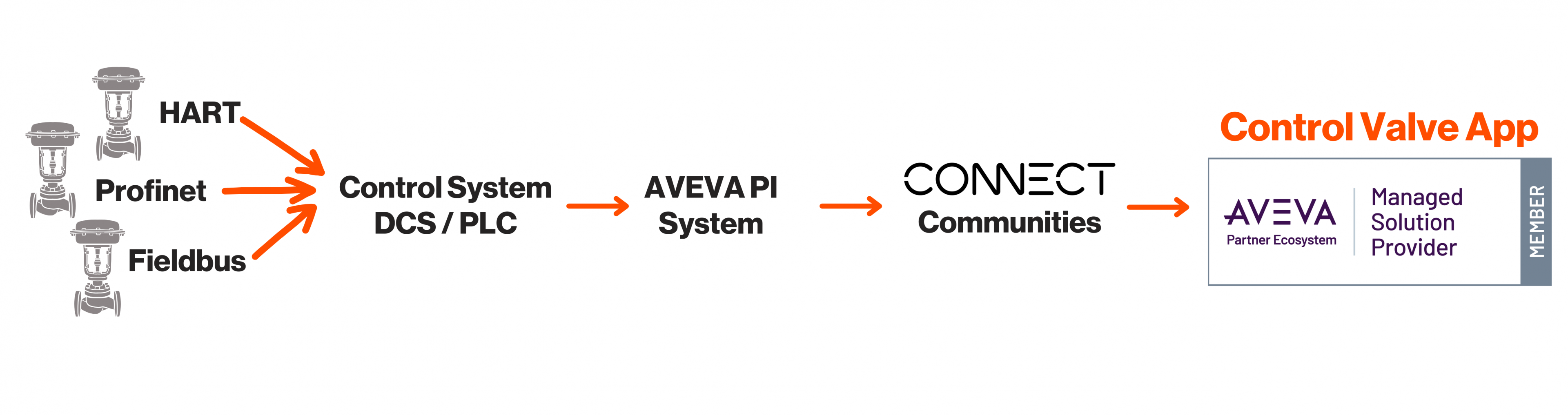
And explains why this architecture removes integration complexity and accelerates time-to-value for both OT and IT teams.
The Starting Point: Control Valves in the Field
Control valves are critical assets in process industries — regulating flow, pressure, temperature, and level. They are given a Controller Output (CO) by a PI, PID or PD algortithm to regulate the flow, pressure, temperature, level and when equiped with positioners that may provide position feedback. In case electrical actuator are used and a Profinet or Fieldbus is used as communication backbone a lot more data may be available from the actuator like torque, stem travel and diagnostic alerts.
However, raw field data alone does not create value. It must be securely collected, contextualized, and made accessible for analytics.
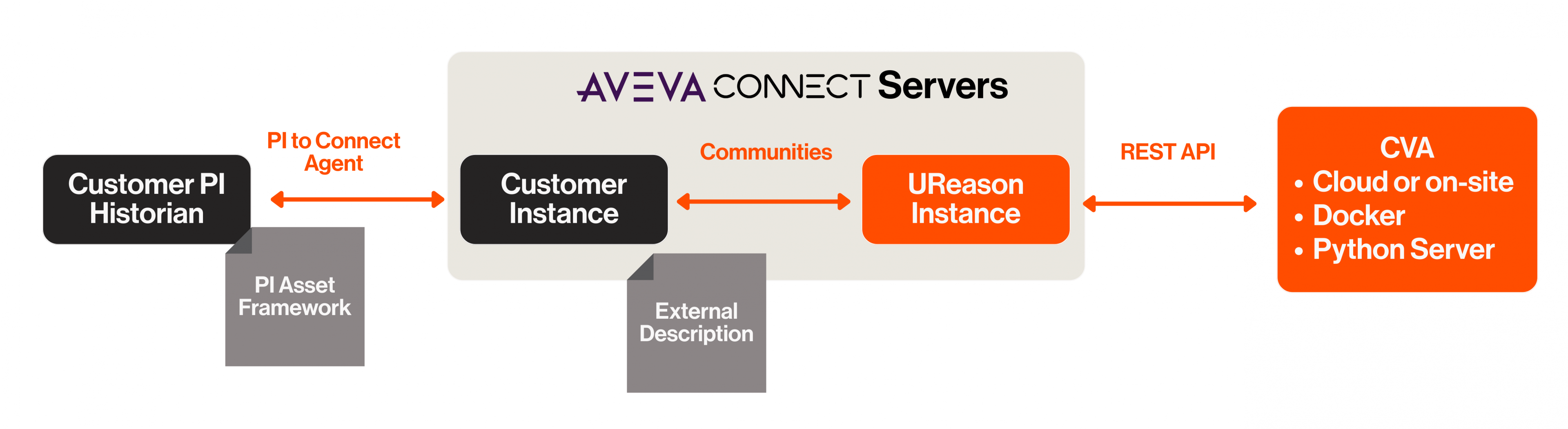
Step 1: Operational Data Collection with AVEVA PI System
The first aggregation layer is AVEVA PI (formerly OSIsoft PI), a real-time industrial data historian widely deployed in plants worldwide.
What Happens Here?
Control valve data flows via:
- DCS/PLC systems
- OPC interfaces
- PLCs
The PI System:
- Collects high-frequency time-series data
- Time-stamps and compresses it
- Ensures data integrity and buffering
- Stores it for historical access
Why This Layer Matters
- Reliable OT-grade data capture
- High-resolution process visibility
- Secure on-premise architecture
- No disruption to existing control systems
At this stage, data is structured—but still primarily plant-bound.
Step 2: Cloud Enablement with AVEVA CONNECT
This is where the architecture shifts from traditional infrastructure to modern, cloud-native access. AVEVA CONNECT acts as the secure bridge between on-prem OT systems and cloud-based applications like UReason.
What CONNECT Does Technically
- Securely synchronizes selected PI data to the cloud
- Maintains data context and asset hierarchy
- Manages identity and access control
- Provides API-based data access
- Eliminates the need for custom point-to-point integrations
Instead of building:
- Custom APIs
- VPN tunnels
- Manual exports
- Middleware stacks
CONNECT provides:
- Standardized cloud connectors
- Centralized tenant management
- Secure, scalable data services
 Step 3: Analytics & Intelligence in the UReason Control Valve App
 Step 3: Analytics & Intelligence in the UReason Control Valve App
Once the data is available via CONNECT, the UReason Control Valve App can:
- Ingest contextualized valve data
- Apply advanced analytics and AI models
- Detect anomalies and performance degradation
- Predict maintenance needs
- Benchmark valves across plants
Because the app consumes data via CONNECT APIs, it does not require:
- Direct access to the control system
- Local installation inside the plant network
- Custom data engineering projects
This dramatically reduces IT workload and accelerates deployment.
Why CONNECT Removes Integration Complexity
Without CONNECT, integrating an analytics application typically requires:
- OT firewall changes
- Security approvals
- Custom API development
- Data model mapping
- On-prem infrastructure provisioning
Each plant becomes a unique integration project.
With CONNECT: A Platform Model
CONNECT introduces a standardized architecture: 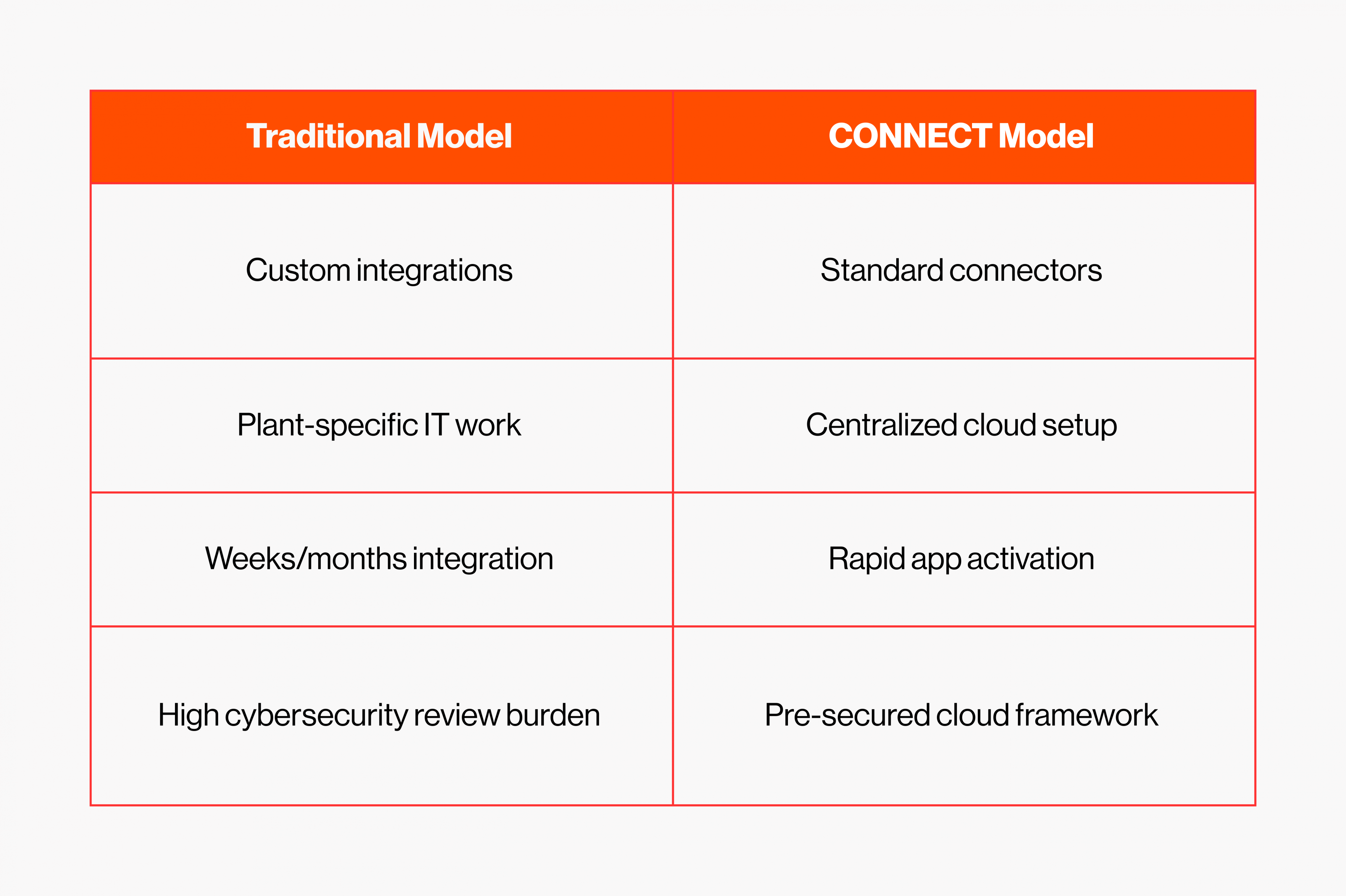
Key Simplifications
- Single Data Backbone
PI feeds CONNECT once. Multiple applications can consume the same data. - Cloud-Native Access
Applications interact through APIs—not plant firewalls. - Identity & Governance Built-In
Role-based access, tenant management, and auditability are centralized. - Scalability by Design
Add another plant? Enable PI-to-CONNECT sync. No new custom build required.
For IT teams, this means lower integration overhead.
For OT teams, this means minimal operational disruption.
Cloud-Native Architecture: Accelerating Time-to-Value
Time-to-value is often delayed not by analytics—but by infrastructure. Here’s how the architecture accelerates results:
- No Heavy On-Prem Installations
The UReason app runs in the cloud. No servers. No patching cycles. No local maintenance. - Faster Deployment Cycles Once data is synchronized to CONNECT:- Asset mapping is aligned
– APIs are available
– Analytics can start immediatelyDeployment moves from months to weeks—or even days.
- Centralized Multi-Site Rollout
For enterprises with multiple plants:
– Standardized PI structure
– Central CONNECT tenant
– One UReason deploymentScaling becomes configuration—not engineering. - Continuous Improvement Loop
Because it’s cloud-native:
– Models can be updated centrally
– Performance improvements are immediate
– Insights propagate across sites
What This Means for OT and IT Teams
For OT:
- No interference with control systems
- Data stays reliable and intact
- Faster insight into valve performance
For IT:
- Reduced integration projects
- Standardized security model
- Cloud scalability without plant-by-plant complexity
From Infrastructure to Intelligence
True innovation is not just analytics—it’s architectural simplification.
By combining:
- AVEVA PI System for trusted data capture
- AVEVA CONNECT for secure cloud enablement
- UReason Control Valve App for AI-driven insight
Organizations move from sensor data to actionable intelligence—without the traditional integration burden.
The result?
- Faster deployment
- Lower IT overhead
- Scalable multi-site architecture
- Measurable improvements in valve reliability and maintenance planning
That’s how modern industrial data architecture turns control valve signals into real operational advantage.
Explore How to Turn AVEVA PI Data into Actionable Insights
Contact us today to try the Control Valve App on AVEVA™ CONNECT and see how early issue detection can transform your control valve monitoring and turnaround preparation. Schedule a call with Florian, Solutions Engineering, Data Science & Digitization, to learn more.
Industrial data is only powerful when it’s accessible — now is the time to make it work harder for you.