
Home/Resources/Article/P&ID & Process Insights
By Jules Oudmans
For decades, Piping and Instrumentation Diagrams (P&IDs) have been the backbone of industrial plant design and operations. Every valve, sensor, pump, and pipeline connection lives somewhere in those drawings — but “somewhere” has always been the operative word. A P&ID sitting in a PDF or a CAD file is, at its core, a picture. It communicates brilliantly to a trained human eye, but to a computer, it’s largely inert. That’s starting to change, and the implications for process engineers, safety analysts, and plant operators are significant.
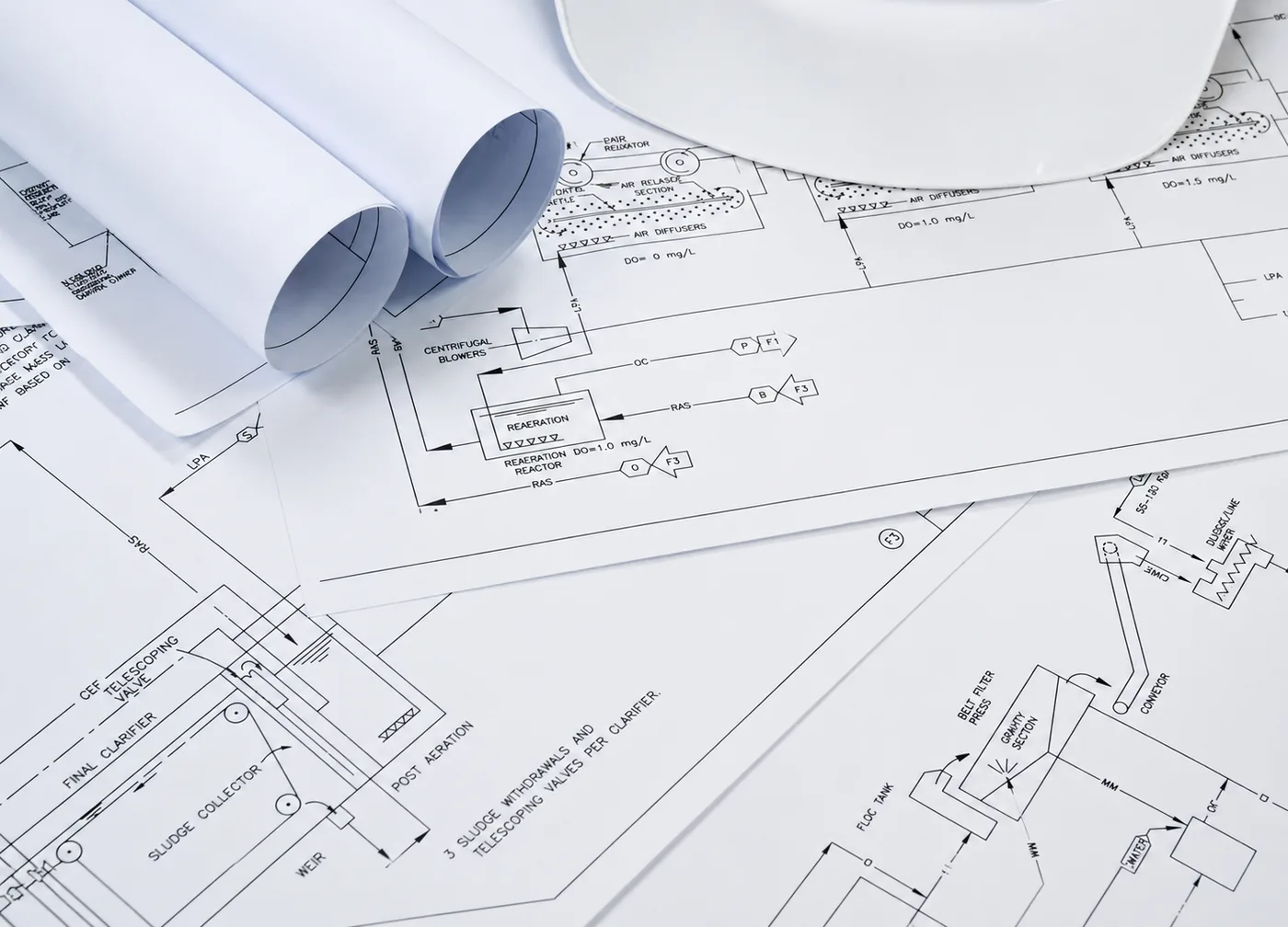
The Problem with Static Diagrams
Traditional P&IDs come in a few common formats. PDFs are the most ubiquitous — flattened, printable, impossible to query programmatically without heavy preprocessing. CAD drawings (DWG, DXF) preserve some layer and geometry information, but the semantic meaning of a symbol — that this circle with a ‘bowtie’ attached is a control valve, not a pump — is typically not machine-readable without a purpose-built parser. DEXPI (Data Exchange in the Process Industry) is arguably the most promising of the existing formats, an XML-based standard that encodes plant topology in a structured way. Even so, DEXPI files are complex, inconsistently adopted across vendors, and still require significant engineering to make queryable in any meaningful sense.
The common thread across all these formats: the knowledge is locked inside. The diagram represents a system, but it doesn’t behave like one.
From Symbols and Lines to Graph Structures
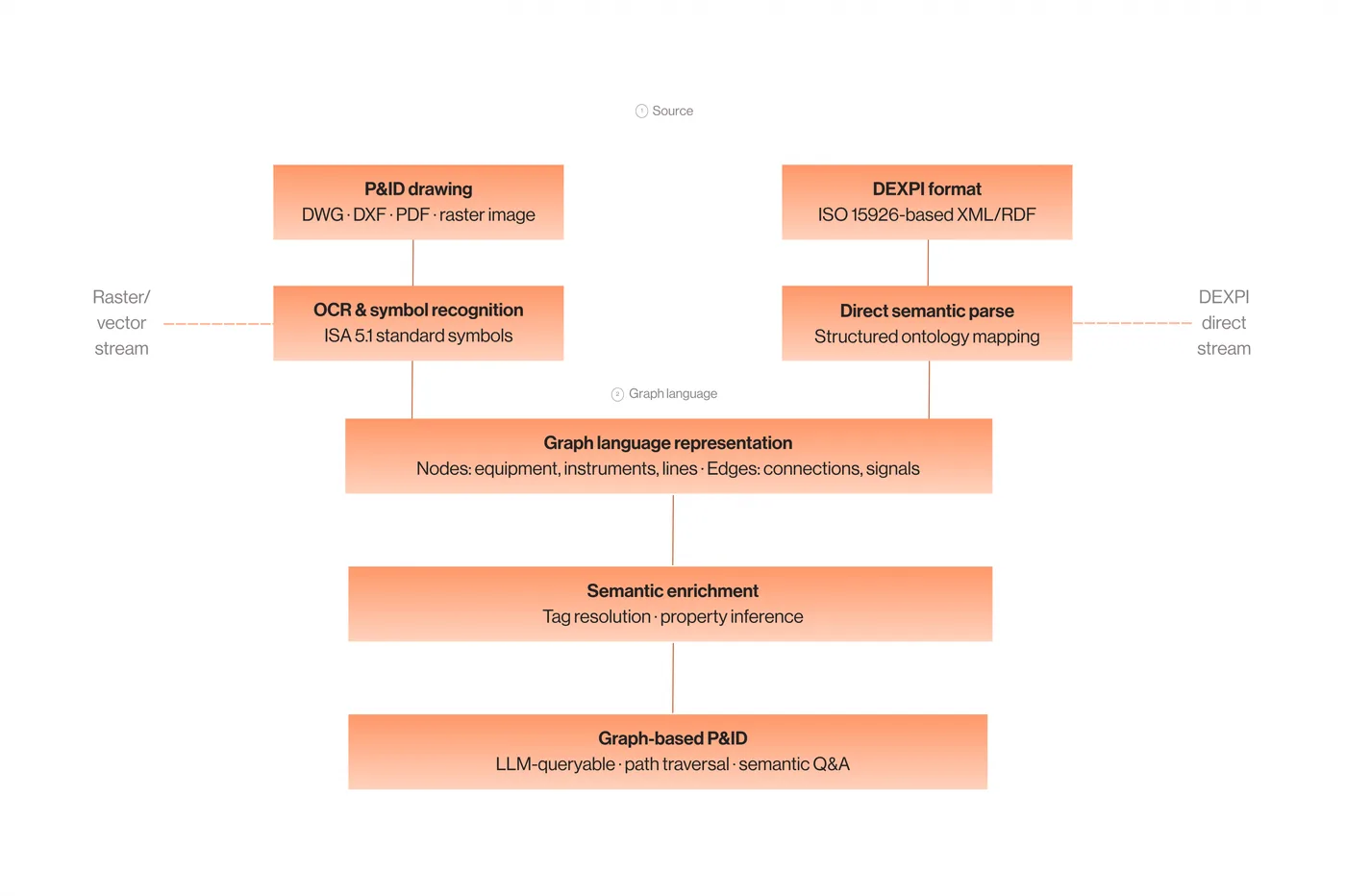
The first transformation required is structural. A P&ID is fundamentally a graph — nodes (equipment, instruments, valves) connected by edges (pipes, signal lines, process flows). The challenge is extracting that graph from whatever format the diagram lives in.
For PDFs and scanned drawings, this means computer vision: symbol detection models trained to recognise ISA 5.1 standard symbols, OCR to capture tag numbers and annotations, and line-tracing algorithms to follow pipe runs between components. For CAD and DEXPI, the path is more deterministic — parsing geometry and XML structure to reconstruct connectivity.
Once you have a graph, everything changes. A valve is no longer a glyph at coordinates (412, 308). It’s a node with properties — tag number, type, normal position, associated instruments — and edges that encode what it connects to upstream and downstream. That graph can be stored in a purpose-built graph database, traversed algorithmically, and, crucially, reasoned over.
Letting LLMs Ask the Right Questions
This is where large language models enter the picture, and where the real capability leap occurs. Once a P&ID exists as a queryable graph, an LLM can serve as a natural language interface to that structure. An engineer can ask: “What happens upstream if XV-1042 fails closed?” and instead of manually tracing lines across three drawing sheets, the system traverses the graph, identifies affected upstream equipment, checks associated pressure relief paths, and returns a structured, human-readable answer.
That question-and-answer loop can extend to process hazard analysis, change impact assessment, maintenance planning, and regulatory documentation. “Which instruments are downstream of this heat exchanger?” “Are there any control loops with more than two transmitters sharing a single final element?” These are questions that today take experienced engineers hours to answer manually.
Why This Is Fundamentally Different from Document QA
It’s tempting to frame this as retrieval-augmented generation over engineering documents — essentially, a smart search engine for P&IDs. But that framing misses what makes graph-based querying genuinely different.
Document QA works on text proximity. An LLM finds passages that look relevant to a question and synthesises an answer from them. It has no understanding of topology, directionality, or causal propagation. It cannot tell you what is upstream of something, because upstream is a spatial and logical relationship, not a textual one.
Graph-based P&ID querying is structural reasoning. The answer to “what fails if this valve closes?” requires traversing a connected system, respecting flow direction, and understanding process dependencies. LLMs provide the natural language interface; the graph provides the ground truth.
Where This Is Heading
The gap between a diagram and a digital twin has always been enormous. Graph-structured P&IDs with LLM interfaces don’t close that gap entirely, but they collapse a meaningful part of it — turning a static artefact into something an engineer can actually have a conversation with. In an industry where the cost of misunderstanding a diagram can be measured in safety incidents and unplanned downtime, that is not a small thing.
UReason has already moved this from concept to practice. Their Process Insights add-on is capable of ingesting P&IDs across all major formats — PDF, DWG, DXF, and DEXPI — and transforming them into queryable graph structures ready for natural language interaction. What sets it apart is the integration layer: Process Insights connects Q&A sessions to live data streams, meaning questions about plant behaviour are answered not just against the static topology of the diagram, but against what the plant is actually doing right now. Further still, the platform links to MCP-based models for individual asset classes — pumps, valves, heat exchangers — enabling the system to reason about equipment-level behaviour, degradation patterns, and operational limits in context. The result is something that sits meaningfully between a traditional P&ID and a full digital twin: a living, queryable representation of a process plant that grows more valuable the more you ask of it.
Turn Static P&IDs into Intelligent, Searchable Systems
Want to turn static P&IDs into interactive, searchable systems? Book a call with Artur Loorpuu, Senior Solutions Engineer in Digitalization, to learn how AI and queryable P&IDs can support smarter operations and maintenance.