The Asset Administration Shell promised to give every physical asset a structured, interoperable digital identity. Three years on, manufacturers, software vendors, and platform providers are finally delivering on that promise — at scale. 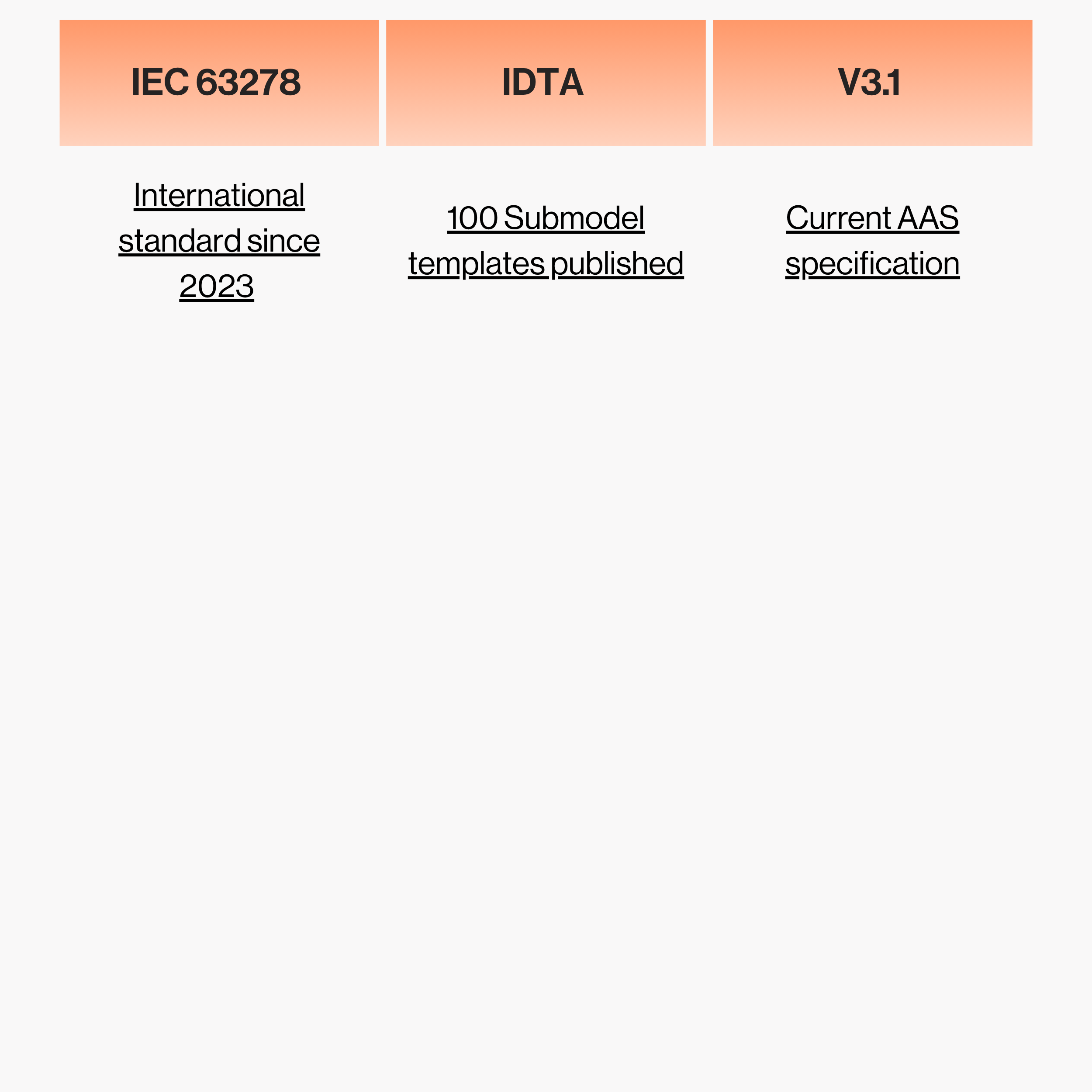 When the Platform Industrie 4.0 working group first sketched the concept of an Asset Administration Shell in 2016, it looked like another ambitious-but-abstract standards initiative — the kind that fills conference agendas for a decade before quietly fading. A decade later, it looks considerably more like the connective tissue of industrial digitalisation. Factory floor controllers, enterprise asset management platforms, digital product passport registries, and AI-driven maintenance systems are converging on a single interoperability layer. The AAS is that layer.
This blog surveys where we are: which systems natively support AAS, which vendors have committed to publishing AAS artefacts for their products, what the leading software platforms can do with those artefacts — and where intelligent asset analytics, exemplified by UReason’s Asset Insights, fits into the picture.
A Structured Digital Identity for Every Asset
The Asset Administration Shell is a standardised digital representation of an asset — a motor, a pump, a PLC, a transformer, an entire production line. It packages information about that asset into a hierarchical structure of submodels: discrete, typed data containers covering distinct concerns such as nameplate identification, technical properties, documentation, carbon footprint, predictive maintenance data, and software versioning. 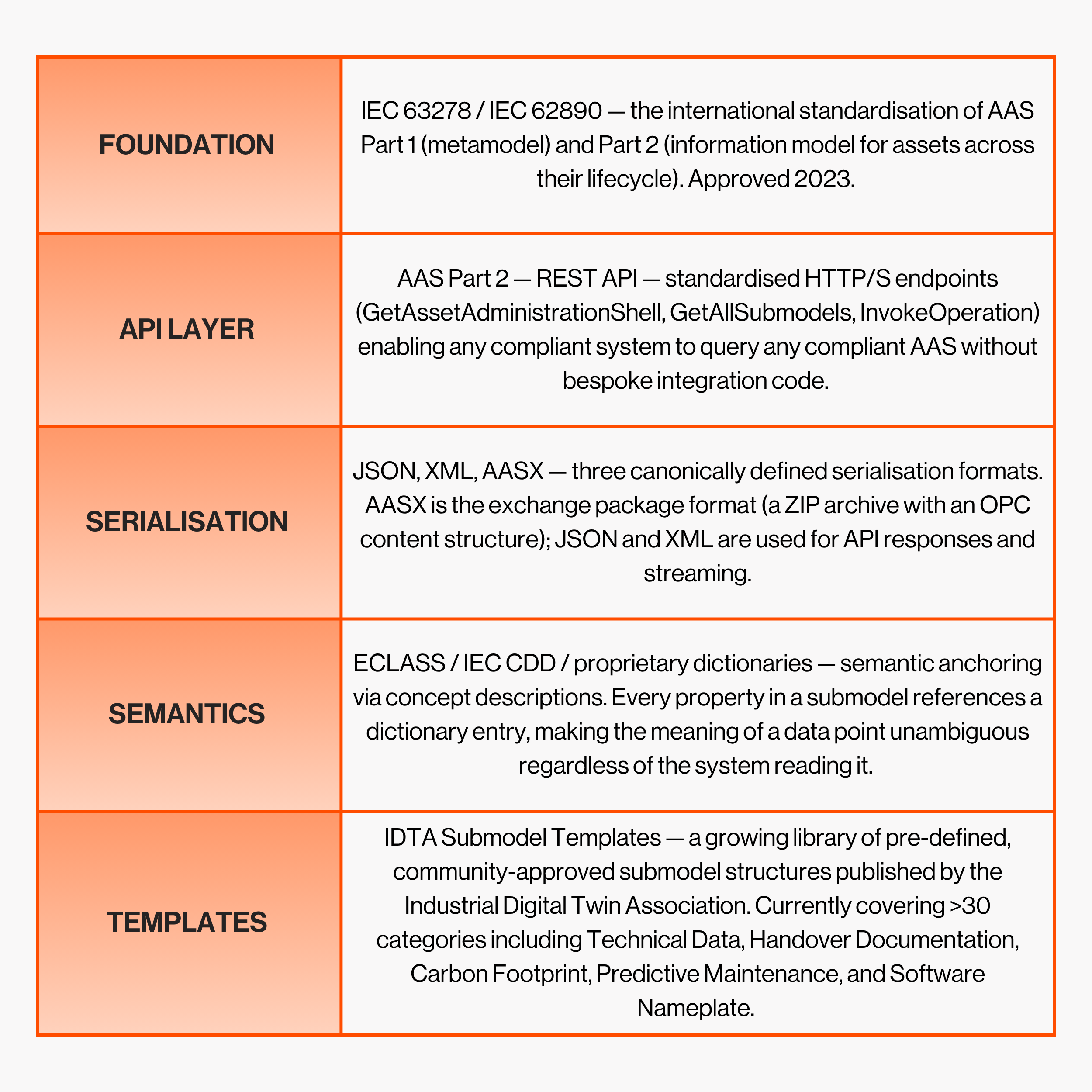
What makes AAS more than just another XML schema is its combination of structural rigour with semantic grounding. Data fields are not just named; they are typed against an internationally maintained dictionary. A “rated current” field on a motor AAS from Siemens means exactly the same thing as the same field on a motor AAS from ABB — because both reference the same ECLASS concept description. That machine-readable equivalence is what makes cross-vendor interoperability possible without custom mapping code.
Who Is Building What
The vendor landscape around AAS has matured from a handful of research-adjacent pilots into a broad ecosystem spanning automation OEMs, industrial software platforms, cloud hyperscalers, and specialist analytics companies. Support takes three distinct forms: publishing AAS artefacts for physical products, embedding AAS as a first-class data format in software platforms, and providing tooling for creating, managing, and querying shells.
The most concrete signal of AAS adoption is when a manufacturer publishes machine-readable AAS files for its physical catalogue. This is the point at which the standard stops being theoretical and starts delivering value: a system integrator can pull structured product data directly from the manufacturer’s registry rather than re-keying specifications from PDF datasheets.
 A Live AAS in the Field: WAGO’s Public Registry
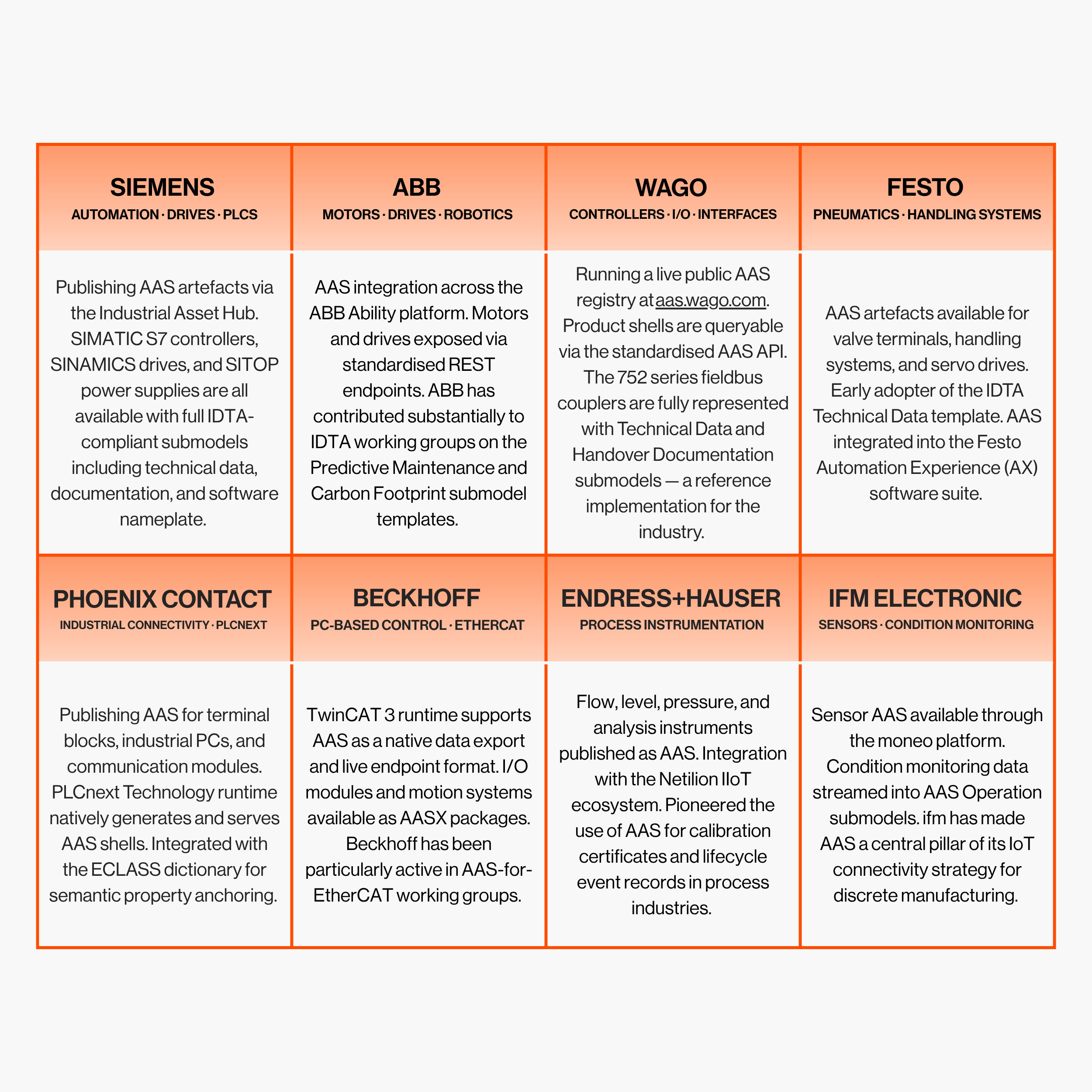
WAGO’s public AAS registry is one of the most accessible demonstrations of what production-grade AAS deployment actually looks like. Any developer or system integrator can query it directly — no credentials, no vendor relationship required. The registry is queryable at aas.wago.com and exposes product shells via the standardised AAS Part 2 REST API.
What makes the WAGO implementation noteworthy is not only its completeness but its accessibility. The entire registry is openly browsable through the WAGO AAS viewer — a web interface that resolves any shell URL into a human-readable property tree. This is the pattern other manufacturers should follow: the machine-readable API serves software integrations, while the browser-accessible viewer reduces the barrier for engineers who want to explore product data without writing a single line of code.
The Carbon Footprint submodel is particularly significant in the WAGO implementation, as it anticipates the Digital Product Passport requirements under the EU Ecodesign for Sustainable Products Regulation. Products that already carry AAS shells with carbon footprint submodels will have a considerably shorter path to DPP compliance than those starting from scratch.
The Expanding Gallery of Published AAS Artefacts
WAGO is far from alone. Across industrial sectors, manufacturers are publishing AAS artefacts ranging from complete, live-queryable registry endpoints to AASX package downloads accompanying product documentation. Some examples:
- Siemens — SIMATIC S7-1500: Full AAS with Technical Data, Software Nameplate, and Documentation submodels published via the Industrial Asset Hub. Queryable via standardised API; AASX download available for offline integration tooling.
- Festo — VTSA Valve Terminal: AAS covering pneumatic valve terminals with full ECLASS-anchored Technical Data submodel. Integrated into Festo AX for predictive maintenance analytics.
- ABB — ACS880 Industrial Drive: AAS accessible through ABB Ability. Includes motor nameplate, operational parameters, and carbon footprint submodel. Used in circularity pilots for end-of-life routing decisions.
- Endress+Hauser — Proline Promag: Flow meter AAS with calibration certificate data, process measurement history, and lifecycle event log. Demonstrates AAS as an alternative to paper-based compliance documentation in process plants.
- Phoenix Contact — AXC F 2152 PLCnext: Runtime-generated AAS from PLCnext Technology. The shell is dynamically updated with operational data — not just a static product record but a living asset representation.
- Bosch Rexroth — ctrlX CORE: AAS integrated into the ctrlX OS ecosystem. Shells generated from the ctrlX Data Layer at runtime; consumed by ctrlX Works engineering tools and third-party analytics systems.
- Pepperl+Fuchs — IO-Link Masters: AAS published for IO-Link devices including sensor and actuator nameplates. Integration with the IO-Link Device Tool enables AAS import/export from existing device configuration workflows.
- Murrelektronik — I/O System MVK Metal: AASX packages published alongside product documentation. Demonstrates AAS adoption reaching into mid-tier industrial componentmanufacturers, not just tier-1 automation OEMs.
To my current knowledge the only vendor that lists with a fully open, no-login-required, directly queryable public AAS registry is WAGO. The others distribute AAS artefacts through support portals, product download pages, or platform-gated environments where the specific URLs either require authentication or change with product catalogue updates.
The Platform Layer: Who Is Consuming AAS
Published shells are only valuable when software can consume them. A second category of AAS adoption — equally important — is the embedding of AAS support into industrial software platforms: MES systems, CMMS tools, asset management suites, digital twin platforms, and analytics engines.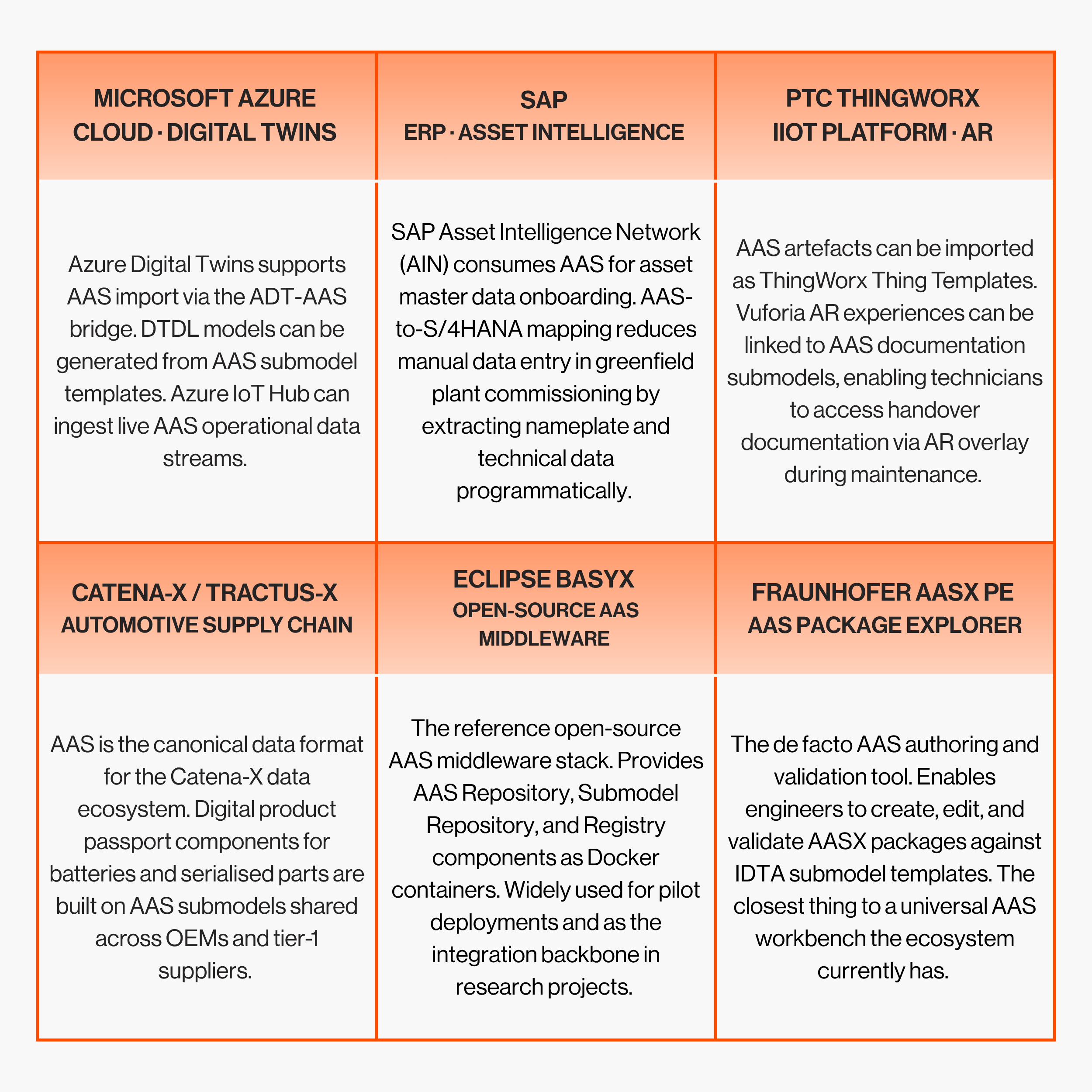
And there is open source momentum: Eclipse BaSyx, now a fully graduated Eclipse Foundation project, is driving standardisation of the AAS middleware layer. Its components — the AAS Repository, Submodel Repository, Registry, and AAS Web UI — are deployed in production environments across automotive, chemicals, and discrete manufacturing. The project’s governance model ensures vendor-neutral development, reducing the risk of any single company capturing the AAS infrastructure market.
Turning AAS Data into Actionable Intelligence
Having a well-structured AAS for every asset in a plant is necessary but not sufficient. The asset’s digital shell is only as valuable as the decisions it enables. This is where UReason’sAsset Insights enters the picture — a condition monitoring and predictive intelligence platform designed to consume AAS-structured data natively and transform it into actionable maintenance and reliability insights.
UReason has been working at the intersection of knowledge-based AI and industrial asset management for over two decades. Asset Insights represents the convergence of that domain expertise with the AAS ecosystem: rather than requiring custom integration for every asset type, the platform leverages the standardised submodel structure to understand asset properties, operating parameters, and failure modes automatically — without bespoke configuration for each manufacturer’s data format.
In practical terms, this means that when a new asset joins a plant’s AAS registry — whether it is a drive from ABB, a controller from WAGO, or a pump from any compliant manufacturer — Asset Insights can immediately begin reasoning about its operating behaviour against the specifications declared in its Technical Data and Predictive Maintenance submodels. The structured semantics of AAS remove the traditional integration bottleneck. 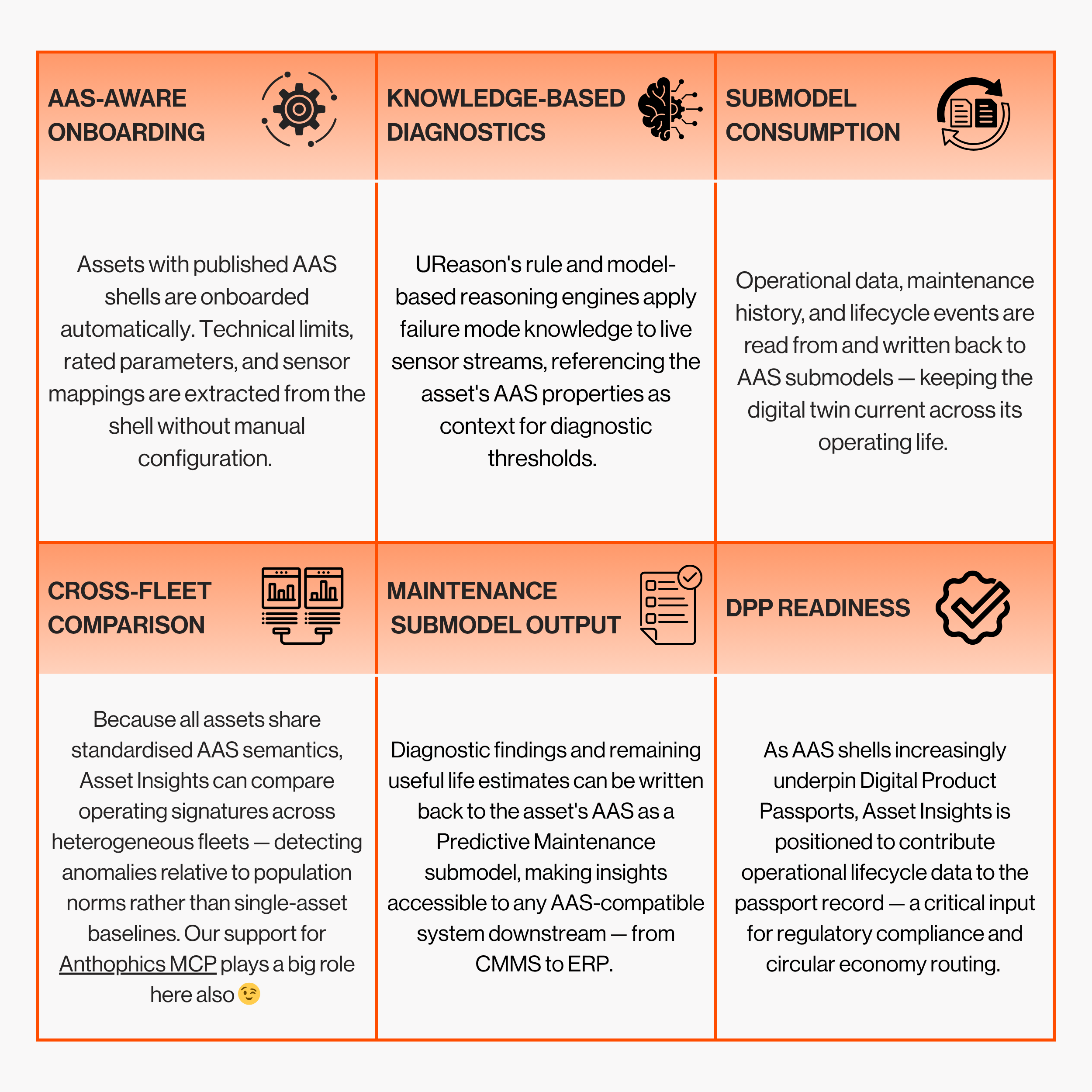 The strategic value of UReason’s approach is particularly clear in mixed-OEM environments — the reality of most industrial facilities. Where a traditional condition monitoring deployment requires weeks of per-asset integration work for each new equipment type, an AAS-first approach with Asset Insights collapses that timeline. The common data model does the heavy lifting that previously fell to integration engineers.
Open Challenges and What Comes Next
The AAS ecosystem has achieved genuine critical mass, but it is not without friction. Three challenges dominate industry conversations heading into the second half of the decade.
1. Data Quality and Completeness
Publishing an AAS shell is not the same as publishing a good AAS shell. Early deployments reveal wide variation in submodel completeness — a manufacturer may populate the Nameplate submodel exhaustively while leaving the Carbon Footprint or Predictive Maintenance submodels empty or sparsely filled. The IDTA is addressing this through mandatory field definitions in submodel templates, but enforcement depends on buyer pressure, not just standards governance. As AAS shells feed directly into Digital Product Passport requirements, the commercial incentive to populate them fully will intensify.
2. Registry Discoverability
Finding the AAS for a specific product from a specific manufacturer currently requires knowing where that manufacturer’s registry lives. WAGO’s registry is at aas.wago.com; Siemens’ is embedded in the Industrial Asset Hub; others distribute AASX files through their product portals. There is no single lookup service — yet. The work on the IDTA’s Discovery Service specification, and the broader EU DPP registry work expected to launch in mid-2026, will begin addressing this (also see my previous blog). Until then, integration teams must manage registry endpoints as configuration rather than discovering them dynamically.
3. Skills and Tooling
AAS authoring remains more complex than it should be. The Fraunhofer AASX Package Explorer is powerful but dense; the learning curve for engineers who are not already fluent in the metamodel is steep. The next wave of adoption depends on AAS creation being embedded into existing engineering workflows — CAD tools, product configuration systems, PLM platforms — rather than requiring dedicated AAS expertise. Several tool vendors are working on this; it remains the most consequential bottleneck for long-tail adoption among smaller manufacturers.
Despite these frictions, the trajectory is clear. AAS has moved from consortium aspiration to production infrastructure in the space of five years. The combination of IEC standardisation, IDTA template governance, open-source middleware, and an expanding gallery of real product shells from leading manufacturers has created a genuine network effect. Every new shell published by a manufacturer increases the value of every AAS-capable software platform. Every software platform that consumes AAS increases the incentive for manufacturers to publish. The flywheel is spinning.
The remaining question is not whether AAS will become the interoperability standard for industrial digital twins — it already is, in the sectors that matter most. The question is how quickly the ecosystem can resolve the quality, discoverability, and tooling gaps that stand between where it is today and the seamless, universal asset intelligence infrastructure the original vision promised.
Prepare early for Digital Product Passports
Organisations that prepare early for a central Digital Product Passport (DPP) registry can turn regulatory requirements into a competitive advantage. Schedule a call with Artur Loorpuu, Senior Solutions Engineer in Digitalization, to see how your product data can be structured, connected, and made ready for seamless integration into future DPP registry systems.