Every product in Europe may soon carry a digital identity card crammed with product technical and sustainability data. But where do all those passports actually live — and who can read them?
Imagine walking into a library where every book has a spine but no catalogue. You can pull individual volumes from the shelf, but you cannot search the collection, verify which edition is authoritative, or confirm that the books on one shelf in Berlin match the ones under a different label in Milan. That is more or less the state of Digital Product Passports today.
The concept of the Digital Product Passport (DPP) is elegant: attach a structured, machine-readable record to a physical product that travels with it through every stage of its life — manufacture, sale, repair, resale, and end-of-life recycling. Regulators, buyers, recyclers, and consumers can all query the same record and trust what they find. But elegance in concept has, so far, run ahead of infrastructure in practice.
“A passport without a border crossing to check it is just a very well-formatted piece of paper.”
The Problem: Islands of Data
The European Union’s Ecodesign for Sustainable Products Regulation (ESPR), which entered into force in 2024, mandates DPPs for a broad range of product categories — batteries first, then textiles, electronics, furniture, construction products, and more. Each category will have its own delegated regulation specifying exactly what data fields are required and how they must be structured.
What the regulation has not — yet — mandated in full operational detail is a single place to find all of these passports. In the meantime, producers, industry consortia, and national governments have been building their own registries and data intermediaries. The result is a proliferating ecosystem of pilot programmes, sector-specific databases, and proprietary platforms that each work slightly differently and largely cannot talk to each other. 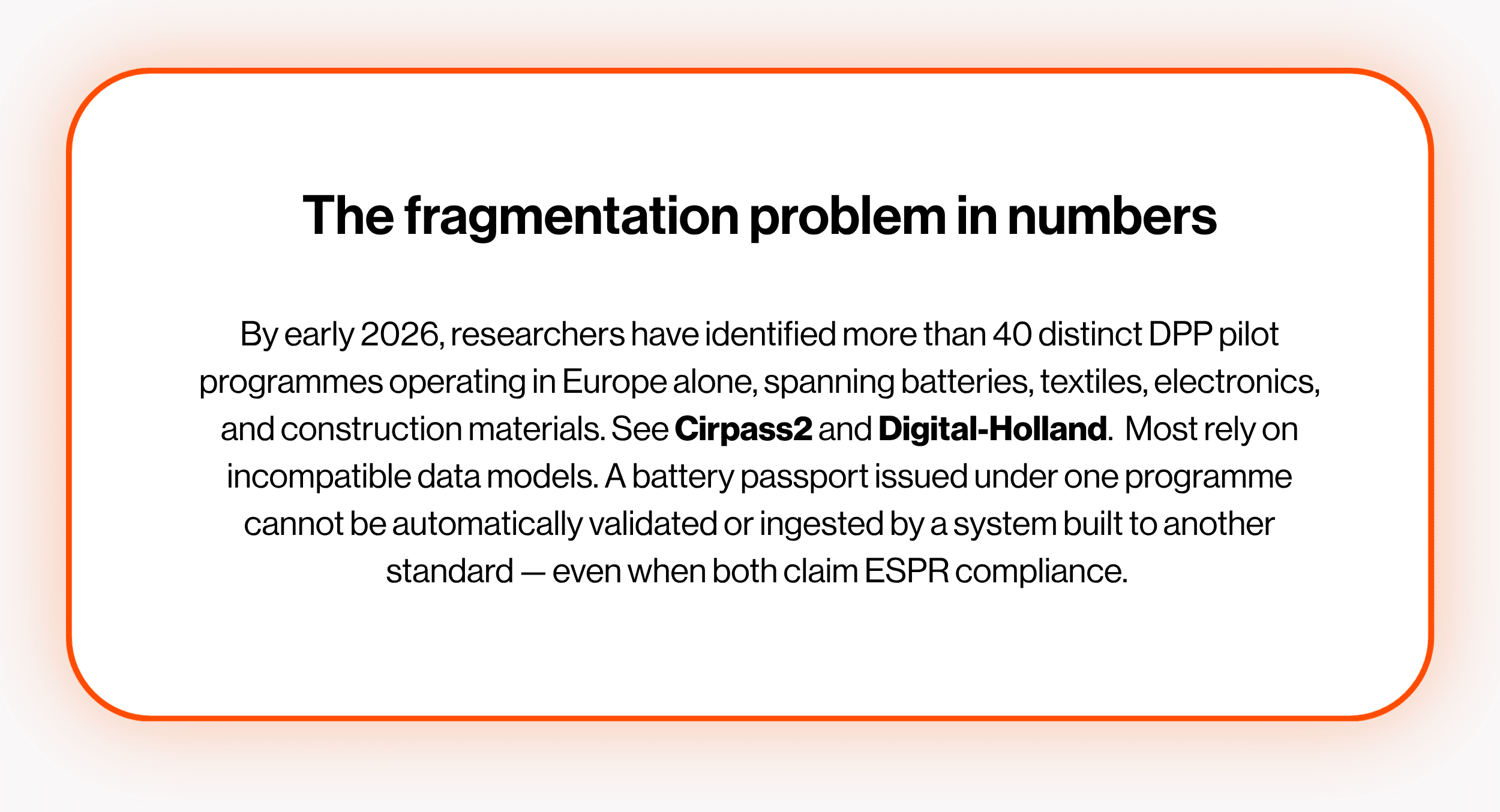
What a Central Registry Is — and Why It Matters
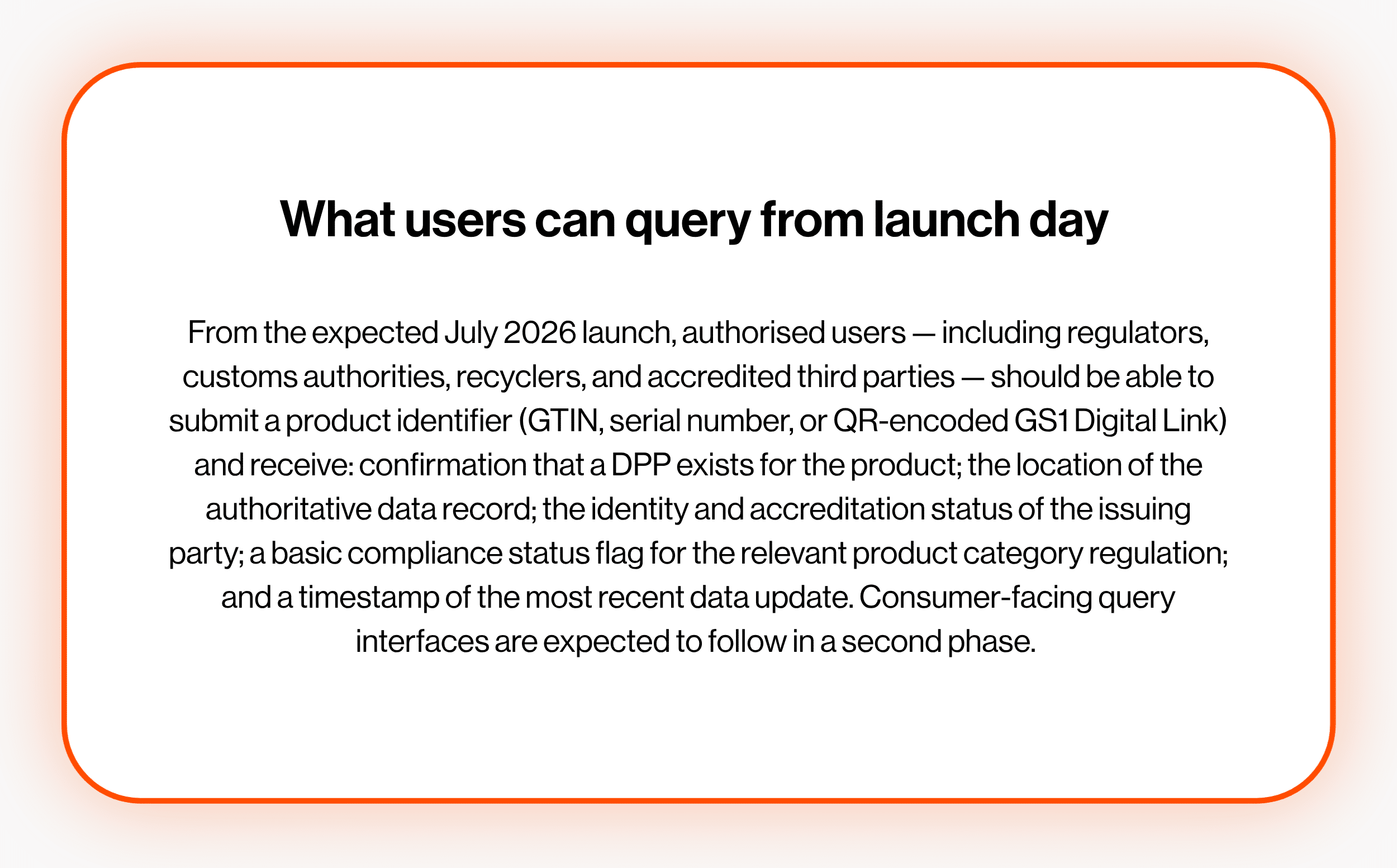
A centralised DPP registry is, at its core, an index. It does not necessarily store all the passport data itself; in the architecture most regulators and standards bodies have converged on, the actual product data can remain distributed across manufacturer systems, certified intermediaries, and sectoral databases. What the registry provides is discoverability and trust: a single place to look up whether a DPP exists for a given product, where to fetch it, and whether the issuing party is authorised to issue it.
Think of it less like a filing cabinet and more like the Domain Name System (DNS) of the physical world. You do not store the contents of a website in DNS; you store the address where those contents live and verify that the domain belongs to who it claims to belong to. A DPP registry works in a similar way, binding product identifiers to data locations and to the credentials of the data custodians.
Value to End Users
For the businesses, regulators, and individuals who need to query DPPs, a functioning central registry delivers several distinct kinds of value that fragmented systems simply cannot provide:
- Single lookup point — no need to know which platform a manufacturer chose
- Cross-sector comparison — consistent data structure enables like-for-like analysis
- Verified provenance — trust anchored to authorised issuers
- Audit trails — immutable records for regulatory compliance checks
- Circular economy routing — recyclers can find disassembly data fast
- Consumer empowerment — one scan, trusted sustainability claims
- Anti-greenwashing — data claims backed by verifiable sources
- Market surveillance — regulators can spot non-compliant products systematically
The value proposition is not symmetric across these groups. Regulators and large recycling operators gain the most from systematic discoverability. Individual consumers gain the most from trusted, standardised claims that do not require them to understand which DPP system a brand has enrolled in. Manufacturers, initially bearing the compliance cost, gain from a level playing field where everyone must publish to the same standard and no single platform can extract monopoly rents from being the only credible registry.
Where Things Stand: A Fragmented Present
As of early 2026, there is no single, operational, legally mandated central DPP registry in Europe. What exists instead is a layered landscape of partial solutions.
2022 – 2023
ESPR framework adopted. Battery Regulation mandates DPPs for electric vehicle batteries by early 2026. Pilot programmes and pre-commercial testbeds proliferate, each developing their own data models.
2024
European Commission designates EPCIS (Electronic Product Code Information Services) and GS1 Digital Link as preferred identifiers. DPP standardisation work accelerates in CEN, ISO, and the GS1 community. National pilots in Germany, France, and the Netherlands begin exchanging data via experimental federation protocols.
2025
Battery DPP mandates begin applying to industrial and LMT batteries. The European Commission runs a proof-of-concept for a cross-sector registry gateway under the CIRPASS-2 project. Results are promising but operational deployment remains at pilot scale. The Catena-X initiative connects automotive supply chains but operates as a closed federated network, not a public registry.
July 2026 — Expected Launch
The European Commission is expected to launch the first operational phase of a cross-sector DPP registry infrastructure. Initial scope covers batteries and priority textile categories. The registry will provide lookup and verification services; full data hosting remains distributed.
2027 – 2030
Mandatory DPP roll-out extends to electronics, furniture, and construction products. Registry coverage expected to expand accordingly, with federation to non-EU trading partners under bilateral recognition agreements. 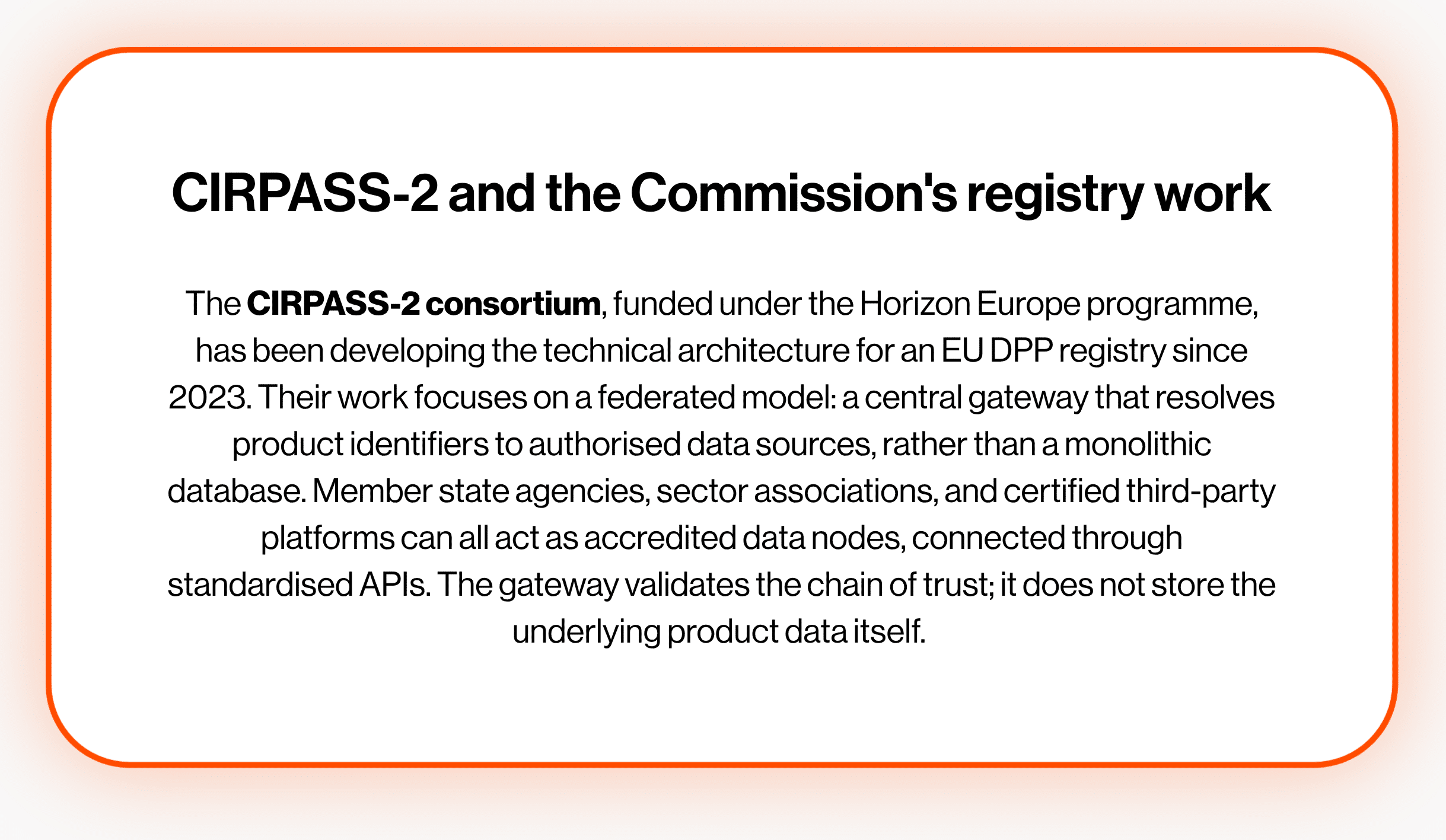
The Expected Data Formats
The AAS format on which I have been sharing multiple posts is one we prefer however multiple formats exist. If the registry is the address book, the data formats are the language. Agreeing on a common language has been one of the most contested and technically complex aspects of DPP standardisation. Several formats have emerged as front-runners, and the expected registry architecture will need to accommodate all of them, or mandate convergence on a subset. 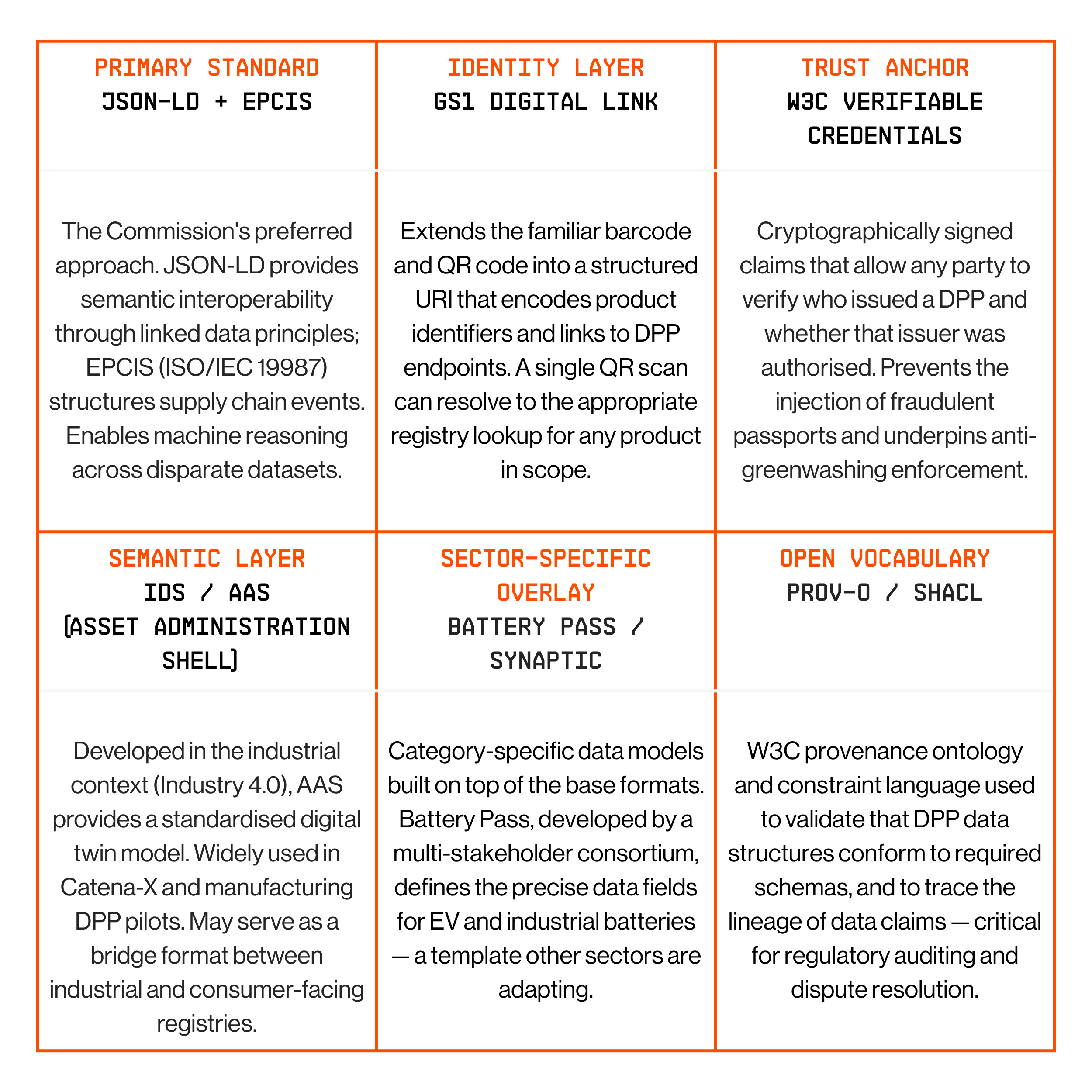
The likely outcome from July 2026 onwards is not a single mandatory format but a mandatory mapping layer: producers may submit data in any of the accredited formats, and the registry translates between them using published crosswalks. This is politically pragmatic — it allows existing pilots and sectoral systems to onboard without rebuilding from scratch — but it introduces complexity at the registry level and risks inconsistency in edge cases.
“The formats are largely ready. The fight is not over syntax — it is over who controls the trust chain, and who pays for the infrastructure.”
The July 2026 Launch: What to Expect 
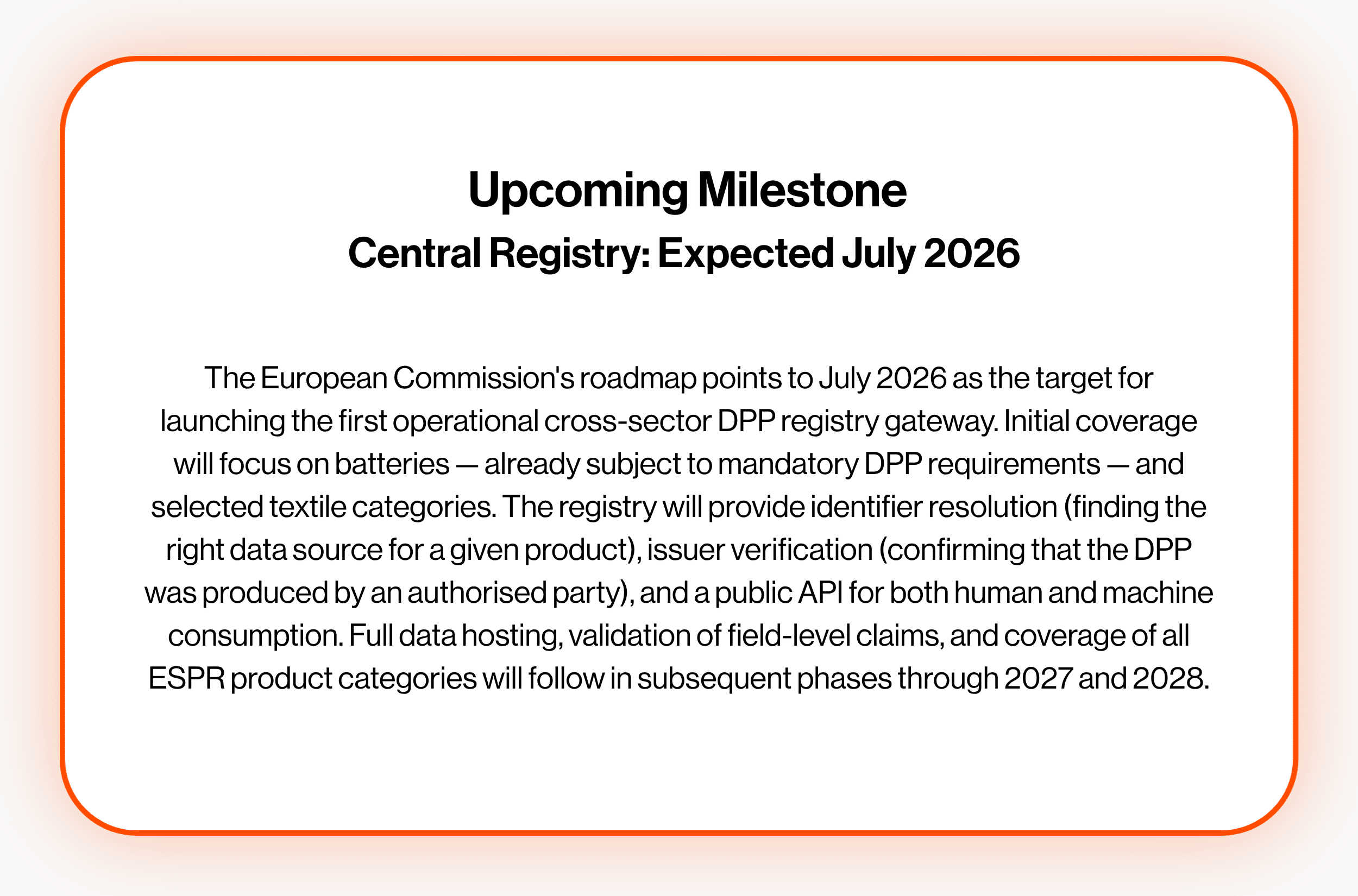
Several important caveats apply to that timeline. First, “launch” in this context will almost certainly mean a production-ready pilot rather than a fully scaled system capable of ingesting the millions of DPPs that a complete roll-out would eventually require. Second, the July date is contingent on political and procurement processes that have already slipped before; it represents the current best estimate, not a contractual guarantee. Third, even a functioning registry gateway will not resolve the underlying fragmentation of data quality — a registry can tell you where to find a passport and who signed it, but it cannot force manufacturers to populate it with accurate or complete data.
Who Gains the Most — and Who Bears the Costs
The political economy of a central registry is as important as its technical architecture. A public registry funded by the Commission and accessible to all consumers levels the competitive playing field for producers and removes the risk that a dominant private platform captures the market. It is, in that sense, a public good. But public goods still require budgets, governance structures, and accountability mechanisms — none of which are trivial to establish and sustain.
Small and medium-sized enterprises stand to gain disproportionately from a well-functioning public registry: rather than having to negotiate individual relationships with multiple sectoral platforms, they can integrate once and reach all buyers, recyclers, and regulators through a single endpoint. Conversely, the compliance burden of generating accurate DPP data falls hardest on smaller producers who lack the data infrastructure of larger corporations — an asymmetry that the registry itself cannot resolve but that policy design around onboarding support and simplified data entry tools must address.
Recyclers and repair operators in the circular economy have an unusually strong interest in the registry’s success. For a recycler processing mixed-composition electronics, the ability to query a DPP and retrieve precise material composition, disassembly instructions, and hazardous substance declarations in seconds rather than hours translates directly into processing efficiency and safety compliance. Today, this information is often absent, incorrect, or locked in proprietary systems. A functioning registry with mandatory, standardiseddisclosure changes that calculus fundamentally.
The Road from Here
The existence of a central registry will not, on its own, make Digital Product Passports work. It is a necessary condition, not a sufficient one. The quality of data feeding into the registry, the breadth of enforcement action against non-compliant producers, the interoperability with trading partners outside the EU, and the accessibility of query interfaces to the full range of intended users — consumers, not just enterprises — are all equally important variables.
But the absence of a registry has been a genuine barrier. Without it, even producers who have invested in building high-quality digital product records have no authoritative place to register them, no mechanism for buyers or regulators to find them through a common channel, and no infrastructure to underpin the trust that makes the data meaningful. The July 2026 launch date, if it holds, represents the moment when the library finally gets its catalogue.
The books have been accumulating for years. It is about time someone built the shelves.
Prepare early for Digital Product Passports
OEMs that act early on ESPR and DPPs can turn compliance into commercial value. Schedule a call with Artur Loorpuu, Senior Solutions Engineer in Digitalization, to see how your existing product documentation can be used to generate DPPs and build a robust data foundation for future delegated acts.