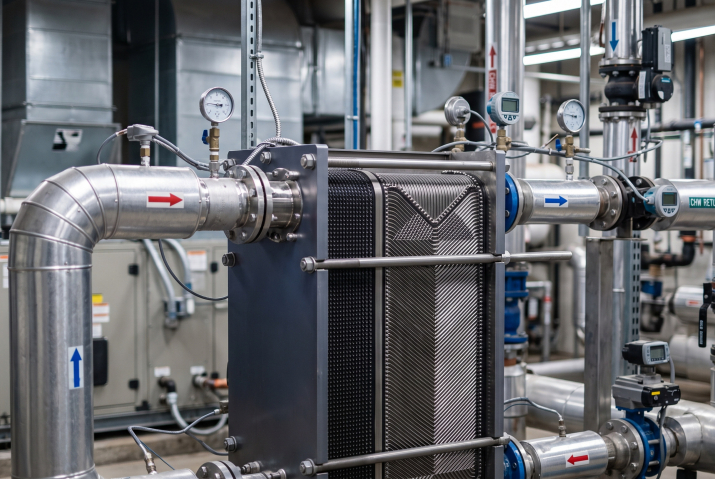
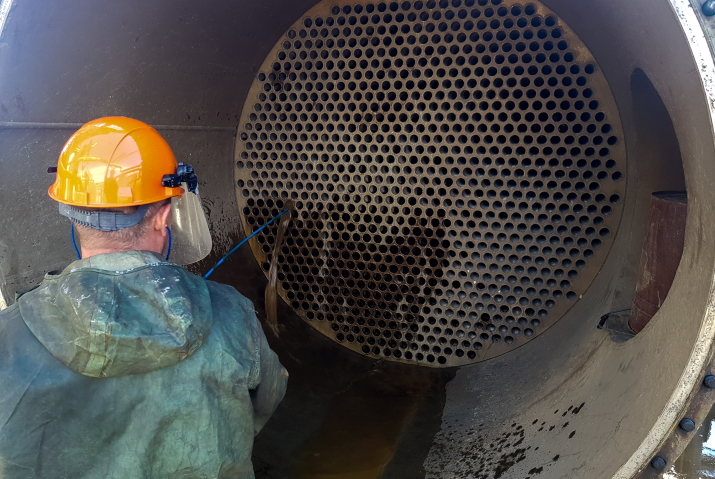
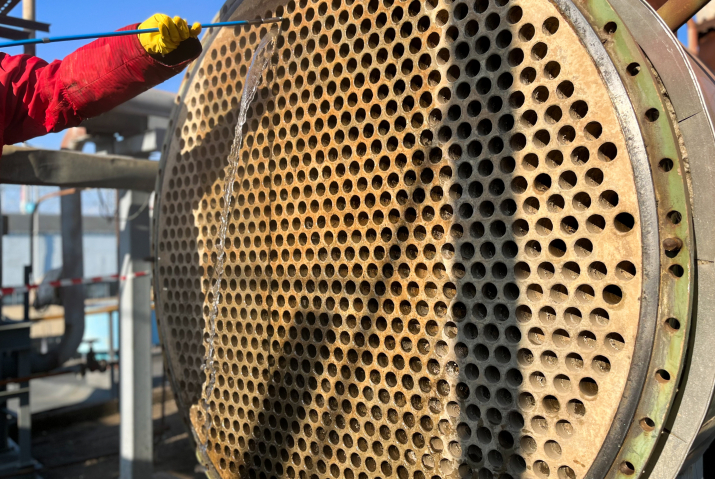
To most people running a plant, pressure drop across a heat exchanger is a cost to be minimized. It’s energy the pumps must overcome, a line on the hydraulic budget, a number you’d rather see low. That instinct isn’t wrong — but it misses something valuable. The pressure drop across an exchanger isn’t just a penalty to pay. It’s a continuous, sensitive readout of what’s happening inside the unit, and it catches problems that thermal measurements can miss entirely.
Here’s the physics in plain terms. Pressure drop is what it costs to push fluid through the exchanger’s flow passages. For a given geometry and fluid, that cost is governed largely by how fast the fluid moves through the available cross-section. Squeeze the passage down — with deposit, with debris, with scale narrowing the tubes — and the fluid has to accelerate through the tighter gap. Because pressure drop scales roughly with the *square* of velocity, even a modest reduction in flow area produces a disproportionately large jump in pressure drop. That sensitivity is exactly what makes it such a good early-warning signal: small physical changes inside the unit show up as large, readable changes in the data.
This is where pressure drop and heat transfer become complementary rather than redundant. Recall that different fouling mechanisms leave different fingerprints. A thin, insulating layer — biofilm, or inversely-soluble scale on a hot surface — hammers heat transfer while barely touching the flow path, so UA falls but pressure drop stays flat. A bulkier, flow-blocking deposit — particulate settling, corrosion products, debris lodging at the tubesheet — may narrow the passage sharply while adding relatively little thermal resistance, so pressure drop climbs steeply while UA looks almost normal. Watch only one signal and you’re half-blind. Watch both and the *combination* starts telling you not just that the exchanger is fouling, but what kind of fouling it likely is.
Pressure drop also picks up things that aren’t gradual fouling at all. A sudden step change — pressure drop jumping overnight rather than creeping up over weeks — usually isn’t deposit building slowly. It’s more likely a physical blockage: debris swept in and lodged, a partially collapsed baffle, a tube plugged at the inlet. Thermal trends are too slow and too smooth to flag that kind of discrete event clearly, but the hydraulic signal snaps to it immediately. The *rate and shape* of the change is itself diagnostic — slow drift versus sudden jump means very different things and very different responses.
There’s a caveat that makes the discipline worthwhile: raw pressure drop, like raw outlet temperature, moves with operating conditions. Push more flow through the unit and pressure drop rises for entirely healthy reasons. So the honest signal isn’t the raw number — it’s pressure drop *normalized* for flow, sometimes expressed as a C-factor or a comparison against the expected clean-condition value at the current throughput. Normalize it, and load-driven noise falls away, leaving the genuine hydraulic degradation behind. That normalized trend is the one worth putting on a health dashboard.
And, as with the thermal side, the raw material is already in hand. The upstream and downstream pressures and the flow rate needed to compute a normalized pressure drop are, for most significant exchangers, already streaming into the historian. Treated as a nuisance, pressure drop is just a bill to pay. Treated as a signal, it’s one half of a two-channel diagnostic — the half that catches the blockages and flow-path problems your temperature data would quietly overlook.
See Heat Exchanger Health More Clearly
Book a call with Artur Loorpuu, Senior Solutions Engineer at UReason, to explore how your existing process data can help detect heat exchanger fouling early, track performance, and support smarter maintenance decisions.