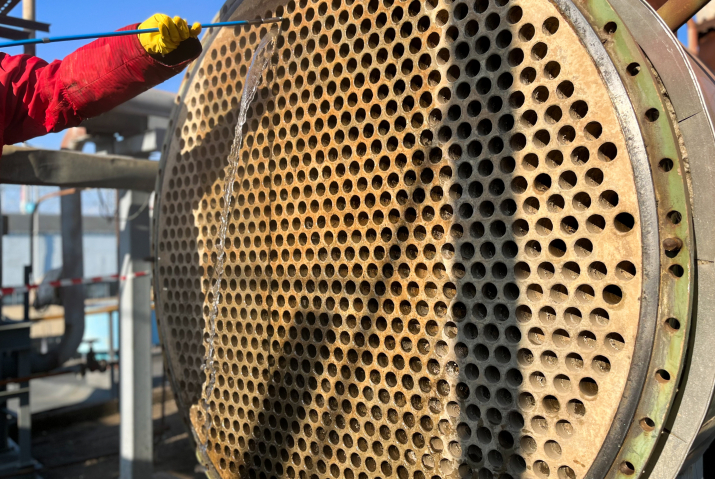
“Fouling” gets used as a single word, but it isn’t a single problem. What accumulates on a heat exchanger surface depends on what’s flowing through it, how hot the surface runs, and how the fluid moves. Four mechanisms dominate in industrial service, and each grows, hurts, and clears in its own way. Knowing which one you’re fighting changes everything downstream — how fast it fouls, what the data looks like, and which cleaning method actually works.
Crystallization (scaling). This is dissolved salts coming out of solution and depositing as a hard crystalline layer — calcium carbonate is the classic culprit in cooling water. What makes it distinctive is that it’s often driven by temperature at the surface, not just concentration. Many scaling salts are inversely soluble: they precipitate more readily on hot surfaces. So the hottest part of your exchanger fouls first and worst. Crystalline scale tends to be dense, well-bonded, and stubborn — usually a job for chemical or mechanical cleaning rather than a quick flush.
Particulate fouling. Here, suspended solids — silt, rust flakes, process fines, corrosion debris from elsewhere in the system — settle out and accumulate. It’s governed by fluid mechanics more than chemistry: it collects where velocity drops and drag can’t keep particles entrained. That means low-flow zones, dead legs, and the shell side of poorly swept units are the usual victims. The practical signal is that velocity is your defense; particulate fouling responds strongly to flow rate, and running an exchanger below its design velocity accelerates it dramatically.
Biological fouling. In systems handling untreated or lightly treated water — cooling loops, seawater services — living organisms form a biofilm on the surface. It behaves unlike the others because it’s self-generating: it grows, and a thin slimy layer can trap particulates and shelter corrosion underneath it, compounding the problem. Biofilm is a strong insulator relative to its thinness, and because it’s biologically driven, it responds to temperature, nutrients, and biocide treatment rather than to flow or solubility alone. Left unmanaged, it’s one of the fastest-developing fouling types.
Corrosion fouling. This one is different again, because the deposit is generated by the surface itself. The metal reacts with the fluid and the corrosion products build up in place as an oxide or scale layer. It’s tied to metallurgy, fluid chemistry, and temperature, and it’s insidious because it doesn’t just insulate — it degrades the tube wall it’s growing on. Cleaning removes the symptom, but the underlying driver is a materials-and-chemistry problem, not just a maintenance one.
Why does the distinction matter? Because these mechanisms leave different fingerprints and demand different responses. Scaling and biofilm are strong thermal insulators, so they show up first as declining heat transfer. Particulate and corrosion fouling often narrow the flow path meaningfully, so they announce themselves through rising pressure drop. Some units suffer several at once — a biofilm sheltering particulates over a corroding surface — which is exactly why a single symptom can mislead you.
This is also why monitoring both the thermal and the hydraulic behavior of an exchanger is so valuable. A drop in heat transfer with little pressure change points one direction; a pressure climb with modest thermal loss points another. The mechanism you’re dealing with dictates how quickly it will progress, when it becomes worth cleaning, and which cleaning method will actually restore performance. Reading the mechanism from the data — before you open the unit — turns fouling from a mystery you discover at turnaround into a problem you can name, track, and plan around.
Stop Paying the Hidden Cost of Fouling
Book a call with Artur Loorpuu, Senior Solutions Engineer at UReason, to explore how your existing process data can help detect heat exchanger fouling early, track performance, and support smarter maintenance decisions.