Two very different recent reports — Epoch AI’s “AI in 2030” (commissioned by Google DeepMind), which extrapolates AI scaling trends forward, and Stanford’s AI Index 2026, which measures what actually happened with AI adoption in 2025. Neither mentions condition monitoring, control valves, or rotating equipment directly. But read together, they say something useful about where CBM and predictive maintenance stand: the modeling techniques are further ahead than industrial adoption is.

Weather prediction is our closest analog
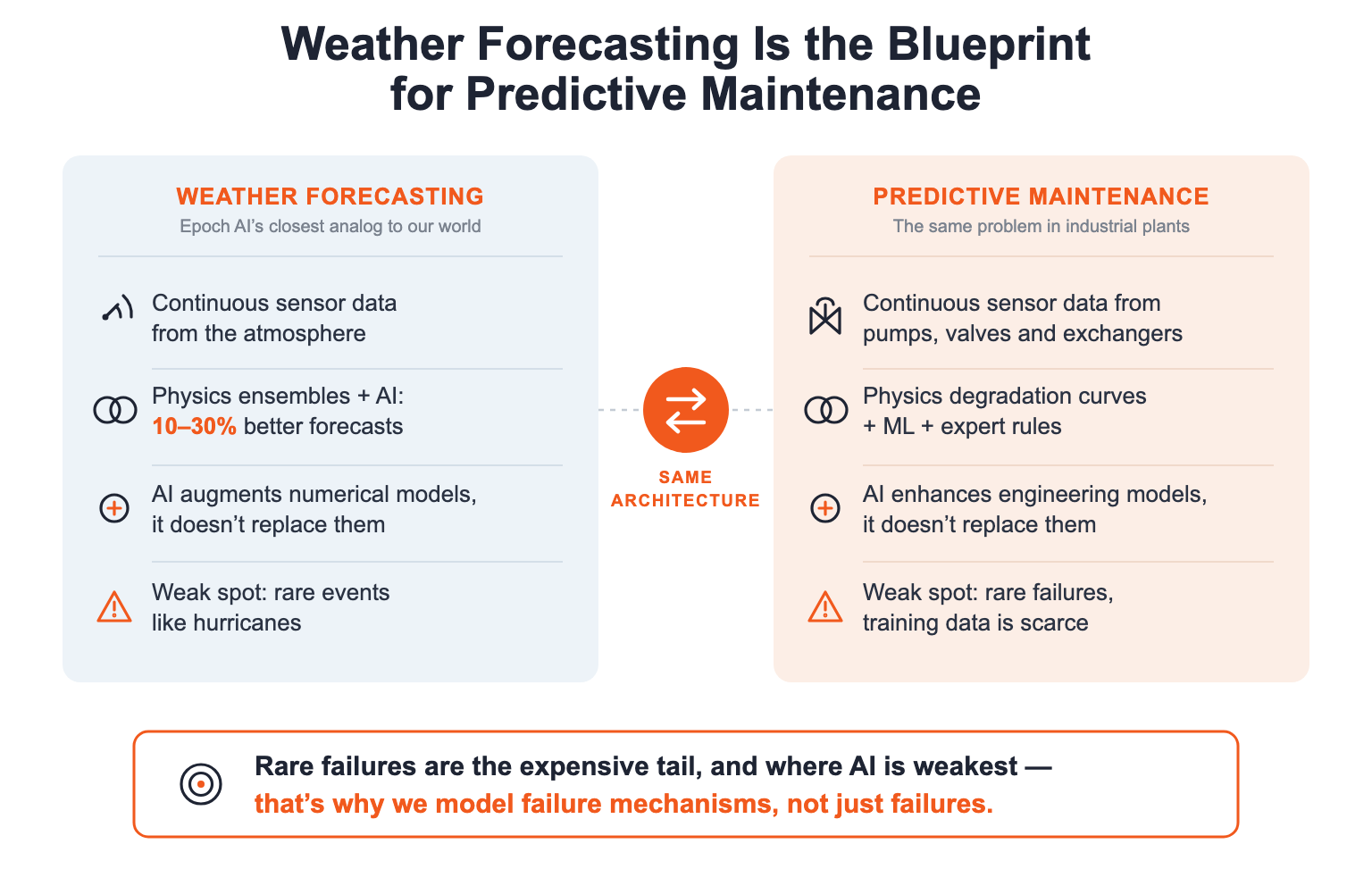
Epoch’s most relevant case study isn’t biology or software — it’s weather prediction, which is structurally identical to our problem: physical systems generating continuous sensor data, forecasting a future state from historical patterns plus physics-based models. Their finding is encouraging: AI weather models already match or beat state-of-the-art numerical ensembles for forecasts from hours to weeks, outperforming by 10–30% on key variables. Crucially, these AI methods augment numerical models rather than replace them. That’s the architecture we know wins in CBM too — hybrid models where physics-based degradation curves (pumps, heat exchangers, control valves) are enhanced by ML and expert rules, not replaced by black-box forecasting.
Data, not compute, is our bottleneck
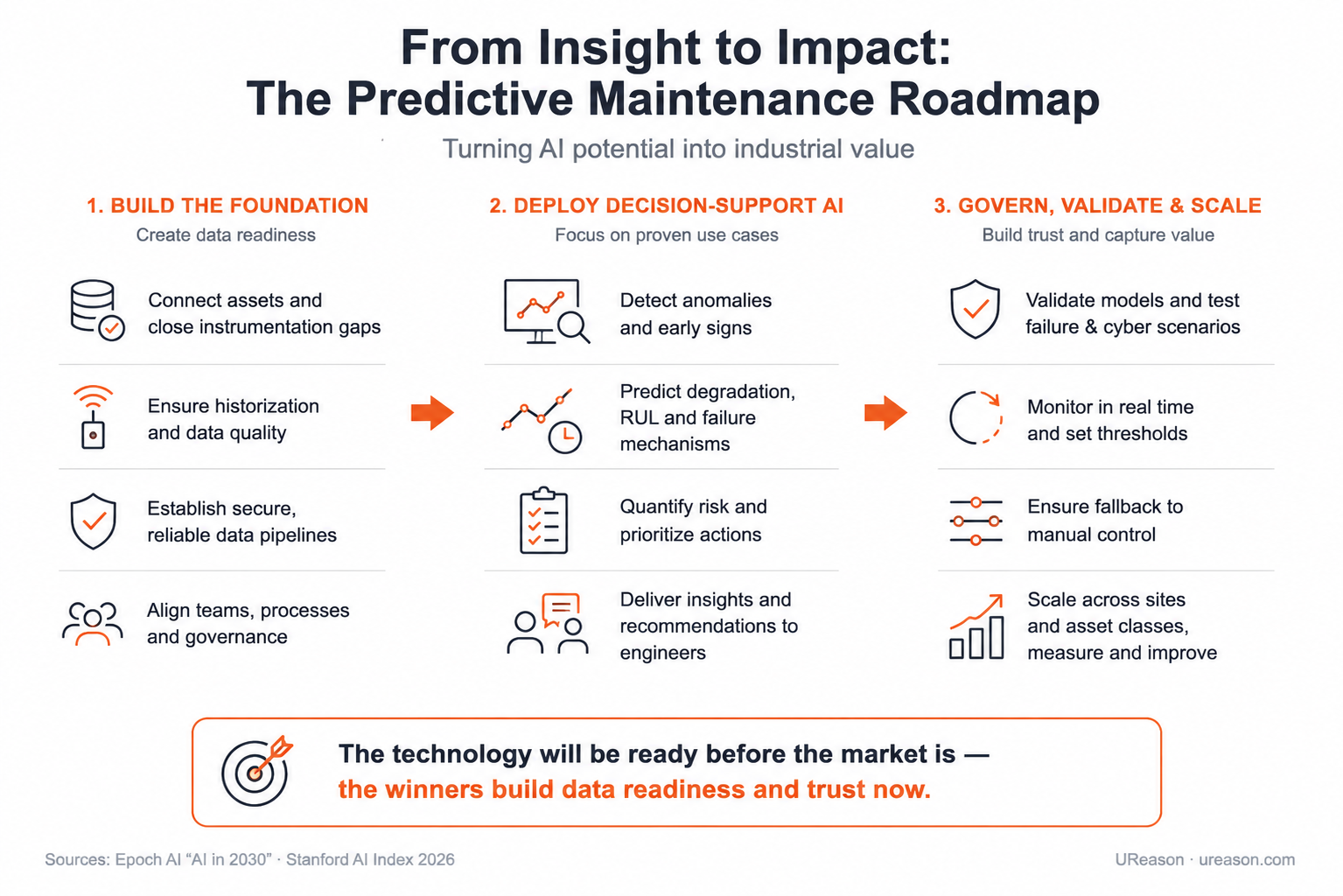
Epoch argues compute is the binding constraint for general-purpose AI, but for domain-specific applications like weather, the real bottleneck is data: instrumentation gaps, collection latency, sensors uploading readings “every few weeks.” This should sound familiar to anyone building tiered data models for asset classes. The implication: the gating factor on AI-driven predictive maintenance isn’t whether algorithms will be good enough — they will be — it’s whether instrumentation, historization, and data governance exist to feed them. Investment in OPC-UA connectivity, site and enterprise data-lakes and CMMS/EAM data quality will matter more than modeling sophistication.
One caution: AI does well on “normal” distributions but has historically struggled calibrating rare events — hurricanes, in Epoch’s case; catastrophic bearing seizures or valve stiction failures, in ours. Since unplanned failures are exactly the expensive tail events maintenance teams care about, this argues against overselling AI-driven RUL predictions on rare failure modes where training examples are scarce by definition. Hence why we don’t docus on failure but failure mechanisms!
Stanford’s Index: adoption confirms the gap
If Epoch tells us what’s technically possible, Stanford’s Index tells us how far the market actually is from using it. Manufacturing shows real results from analytical AI: 56% of respondents linked AI use in manufacturing to cost savings, on par with software engineering as the top category. But agentic AI adoption tells the opposite story — manufacturing has the lowest agent-use rate of any business function tracked, with 91% reporting no agentic AI use at all, worse than supply chain (88%) or even HR (82%). The market isn’t asking “can AI decide for me on the plant floor” yet; it’s still validating “can AI reliably flag the anomaly.” Any agentic pitch to a customer needs to be scoped as decision support, not autonomous action, for now.
The productivity data reinforces this. Multiple 2025–2026 studies compiled in the Index show manufacturing lagging finance and ICT in AI-driven productivity gains — one OECD-based projection puts manufacturing’s 10-year gains well below finance/ICT’s +0.4 to +1.3 percentage points annually. That’s not a data-availability problem the way Epoch’s weather analogy suggests — it’s structural: manufacturing productivity depends on physical asset uptime, which AI improves only indirectly, through better maintenance timing and fewer unplanned outages. That’s precisely the channel CBM and PdM operate through, which means our tools sit on one of the few credible near-term levers manufacturing has for capturing gains other sectors are already banking.
AI-related job postings in manufacturing grew 39% year-over-year in 2025 (from 3.35% to 4.66% of postings) — real movement, but still well behind information services (+69%) and finance (+63%). Consistent with the adoption-stage data: manufacturing is building capability, just from a smaller base and more slowly.
A ready-made governance template
One concrete gift from the Index: its responsible-AI framework includes a worked example that reads like a spec for what we should be building — an industrial control system using anomaly-detection models that are “penetration-tested, evaluated under simulated attacks and sensor failures, monitored in real time, and configured to fall back to manual control when anomalies exceed thresholds.” Grounded in NIST AI RMF, ISO/IEC 42001, and the EU Ethics Guidelines for Trustworthy AI, this is a clean, citable answer to “how do you know the model won’t fail silently”.
What’s missing
Neither report gives us a standardized public benchmark for industrial failure prediction the way weather has ERA5 and WeatherBench, or biology has CASP. That absence is itself a signal: our field lacks the shared, validated benchmarks that let outside observers track progress the way climate and biology communities can. Building toward that — even at industry-consortium level — may be one of the more useful strategic moves available to companies like ours.
Bottom line
Put the two reports side by side and the roadmap comes into focus. Epoch says the underlying modeling techniques — physics-augmented, sensor-data-driven, applicable to CBM the same way they apply to weather — are already good enough to exploit once the data exists, and will keep improving through 2030 largely independent of any one industry’s readiness. Stanford’s Index confirms that industrial adoption, especially of anything autonomous, lags well behind that technical frontier, even as narrower analytical AI is already delivering measurable cost savings. The near-term opportunity for UReason isn’t getting ahead of the market with agentic pitches manufacturing buyers aren’t ready for — it’s deepening trust in well-governed, narrow anomaly-detection and predictive models, backed by a clear fallback and validation story, while quietly building the data infrastructure that determines who actually captures these gains once the market catches up to the technology.
Turn AI into Measurable Maintenance Results
Book a call with Artur Loorpuu, Senior Solutions Engineer at UReason, to explore how Process Insights transforms static P&IDs into interactive engineering systems for troubleshooting, impact analysis, and FMEA workflows.