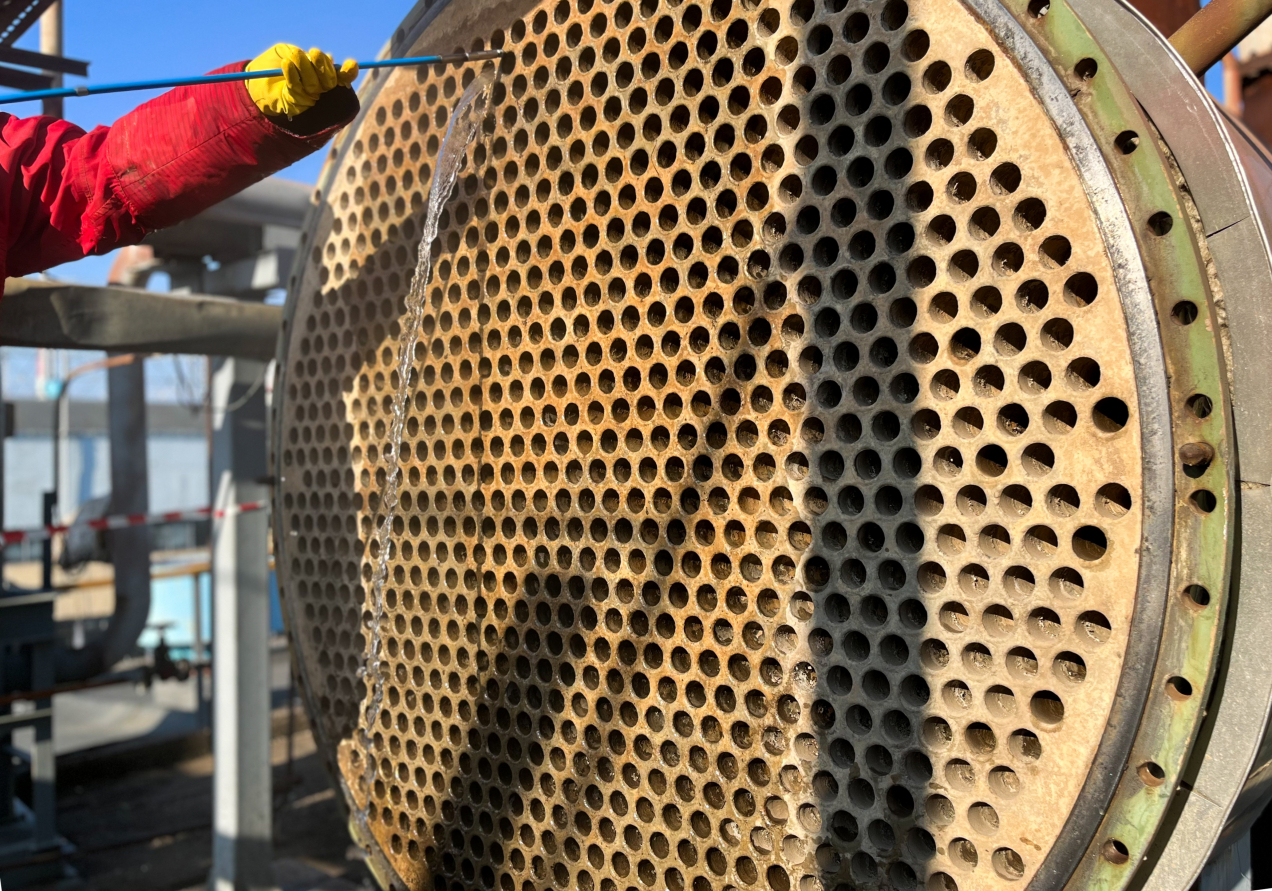
A heat exchanger rarely fails dramatically. It doesn’t trip, alarm, or shut you down overnight. Instead it declines — slowly, silently, and expensively — as a thin film of deposit builds on its surfaces. By the time anyone notices, the plant has often been paying for that fouling for months.
The uncomfortable part is just how little deposit it takes. A fouling layer only a fraction of a millimeter thick can meaningfully degrade performance, because most fouling materials are poor conductors of heat. Scale, biofilm, coke, and corrosion products act like insulation bonded directly onto the surface that’s supposed to be transferring heat. A layer you could barely see with the naked eye can add more thermal resistance than the metal tube wall itself.
That resistance shows up in two ways, and both cost money.
The first is the energy penalty. As fouling grows, the exchanger transfers less heat for the same surface area. To hit the same process temperature, something else has to make up the difference — more steam, more fuel to a fired heater, more duty on a downstream chiller. None of it is visible on a single gauge. It hides inside your utility bill, distributed across the whole plant, which is exactly why it goes unquestioned for so long.
The second is throughput. Many fouling mechanisms narrow the flow path as well as insulate it, so pressure drop climbs. Pumps work harder, drawing more power, and eventually a pump or a temperature constraint caps how much you can push through the unit. When an exchanger becomes the bottleneck, you’re no longer just spending extra energy — you’re leaving production on the table. In a continuous process, a few percent of lost throughput compounds into a serious number over a year.
Put those together and you get the quiet erosion of margin. Higher energy input, lower useful output, and — because heat exchangers rarely work alone — knock-on effects across the train. A fouled preheater sends colder feed into a furnace. A fouled condenser raises backpressure on a turbine. A fouled cooler forces a downstream unit to run outside its sweet spot. The cost of one degraded exchanger is rarely contained to that exchanger.
The traditional defense is scheduled cleaning: pull the unit on a fixed calendar and clean it whether it needs it or not. But calendar-based maintenance gets the timing wrong in both directions. Clean too early and you spend labor, downtime, and chemicals removing deposit that wasn’t costing you much yet. Clean too late and you’ve already burned months of excess energy and lost production before the wrench ever turns. Fouling doesn’t follow a calendar, so a calendar can’t tell you when it’s actually worth acting.
What you need instead is visibility — a way to see fouling as it develops, quantify what it’s costing right now, and act at the point where cleaning pays for itself. The encouraging news is that the signals are already there. The temperatures, flows, and pressures streaming into your data/process historian contain everything needed to track an exchanger’s thermal and hydraulic health over time. No new sensors, no shutdown, no capital project — just the data you’re already collecting, interpreted through the physics of how the unit is supposed to behave.
A fraction of a millimeter of deposit is easy to ignore precisely because it’s invisible. But it isn’t invisible in your data. The plants that learn to read those signals stop paying the hidden fouling tax — and start cleaning on the schedule that economics dictates, not the one the calendar happens to suggest.
Stop Paying the Hidden Cost of Fouling
Book a call with Artur Loorpuu, Senior Solutions Engineer at UReason, to explore how your existing process data can help detect heat exchanger fouling early, track performance, and support smarter maintenance decisions.